The New Core KPIs: Measuring Success in a Service Based Architecture
How operators should re-baseline performance, efficiency, and cost measurement for a cloud-native, intent-driven 5GC
7 Minute Read

An operator can hit every EPC-era target — attach success, bearer setup latency, node CPU under threshold — and still miss a degradation that lives in the API chain between network functions rather than on any one node. The 5G Core's Service-Based Architecture (SBA) replaces monolithic network functions with cloud-native NFs that expose HTTP/2 service-based interfaces (SBI), scale independently, and are increasingly managed through intent-driven orchestration. That shift breaks the node-centric KPI model. A KPI framework is emerging around five families — service health, inter-service efficiency, elasticity, intent fulfillment, and economics — plus end-to-end and resiliency measures that span domains. Together they determine how operators manage cost, reliability, and experience on a cloud-native core.
Why EPC-era KPIs break in SBA: The EPC was predictable: fixed nodes, static capacity, deterministic signaling flows, and tight coupling between control and user plane. Its KPIs reflected that world — MME attach success, SGW/PGW session setup, bearer establishment latency, node CPU and memory utilization, and S1/S5/S11 signaling failures. SBA breaks the assumptions behind these metrics in five ways.
- NFs scale independently. A registration storm loads AMF, AUSF, and UDM; a PDU-session surge loads SMF and UPF. Node-centric KPIs cannot capture that distributed behavior. - API calls replace point-to-point signaling. Between control-plane NFs, SBI calls (3GPP TS 29.500) replace Diameter and GTP-C, so success measurement shifts from attach or bearer setup to API reliability, latency, and schema compliance across the service mesh. N2 (NGAP) and N4 (PFCP) remain point-to-point and keep their own KPIs. - Cloud infrastructure abstracts hardware. Node-level CPU and memory are no longer sufficient on their own — they still matter for capacity and noisy-neighbor diagnosis — and elasticity, autoscaling efficiency, and resource pooling become the more telling indicators. - Intent-driven orchestration changes operational logic. The question becomes not whether a node responded but whether the system achieved the operator's intent. - Economics shift toward consumption. Cost moves from fixed node capacity toward pooled compute — largely OpEx on public cloud, still largely CapEx on a private telco cloud — which calls for KPIs that measure cost per service, scaling efficiency, and resource utilization density.
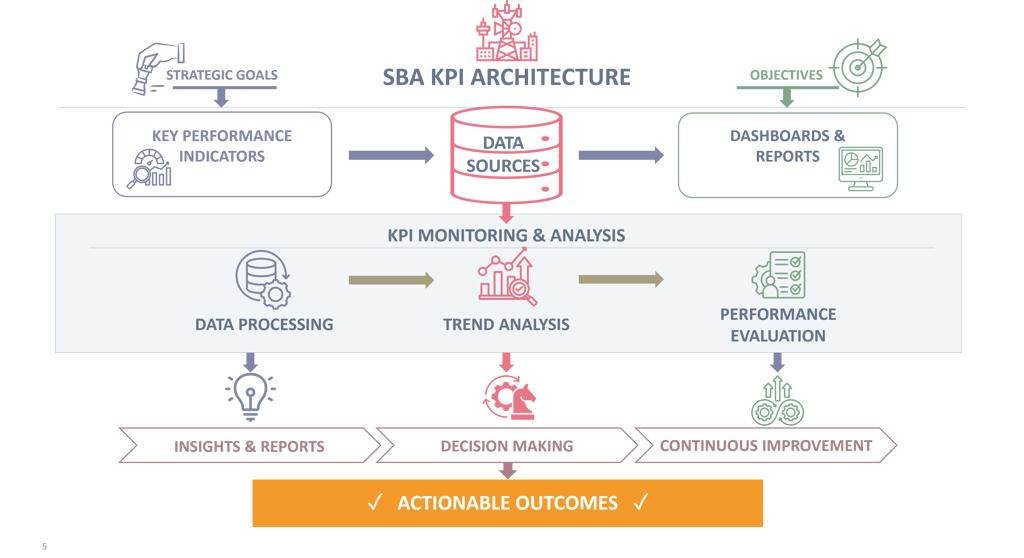
Five KPI families for a service-based core: Five KPI families define success in a service-based core. They do not discard the standardized counters: 3GPP TS 28.552 defines the NF-level performance measurements and TS 28.554 the end-to-end KPIs. The families reorganize that raw material around how SBA actually fails. Service health KPIs measure the reliability, responsiveness, and correctness of each NF service. Control-plane NFs such as AMF, SMF, UDM, PCF, NRF, NSSF, AUSF, NEF, and BSF expose SBI services (Namf, Nsmf, Nudm, and so on) and behave like microservices, so their KPIs must reflect service health rather than node health. API success rate, API latency distribution (tail percentiles, not averages), service availability, service restart frequency, state synchronization accuracy, and registration or session continuity across scale events become essential, because a single degraded API can break mobility, session continuity, or policy enforcement. Inter-service efficiency KPIs measure how well services collaborate across the SBA mesh. SBA is a web of interdependent services, and efficiency across this mesh determines user experience. API call volume per procedure, API retries and failovers, service-to-service latency chains, NRF discovery efficiency (or SCP routing efficiency where the operator uses Rel-16 indirect communication), policy propagation time, and mobility procedure efficiency show not just how each service performs but how services interact. Inefficient chains add latency and cost.
Elasticity and resource KPIs measure how efficiently the core scales, heals, and uses resources. Autoscaling reaction time, scale-out and scale-in accuracy, resource pool efficiency, pod and container lifecycle behavior, horizontal versus vertical scaling ratios, and UPF throughput elasticity all determine cost, performance, and SLA compliance. Under-scaling creates outages; over-scaling creates unnecessary cloud spend.
Intent fulfillment KPIs measure how well the orchestration layer achieves operator-defined intents. Where intent-driven management (3GPP TS 28.312; TM Forum TMF921 Intent Management API) replaces manual configuration, KPIs must measure intent outcomes rather than configuration steps. Intent success rate, intent execution time, policy compliance rate, autonomous remediation efficiency, deviation detection rate, and closed-loop stability define reliability, automation maturity, and SLA performance. For operators moving to intent-driven operations, these become the primary operational KPIs.
Economic KPIs measure cost efficiency, resource utilization, and value creation. Cost per API call, cost per PDU session, cost per slice, resource utilization density, autoscaling cost avoidance, UPF cost per Gbps, and energy efficiency per service instance show how a service-based core behaves economically. These KPIs need an owner outside engineering — typically finance or a FinOps function — because uncontrolled cloud consumption can erode the cost case for a cloud-native core.
Beyond the core: end-to-end and resiliency KPIs: SBA does not operate in isolation, and operators increasingly measure end-to-end KPIs across RAN, transport, and core: end-to-end registration time, slice-level QoS compliance (per S-NSSAI), UPF path selection efficiency, edge offload ratio, transport latency contribution, and RAN-core coordination efficiency. These reflect distributed networks where domain boundaries blur.
Cloud-native deployments must also absorb traffic spikes and isolate faults autonomously. NF instance recovery time measures how fast the orchestrator replaces a failed NF instance and registers it with the NRF, with targets under two seconds for stateless control-plane services — a target that depends on pre-provisioned standby instances and NRF/SCP reselection rather than a cold pod restart. Autoscaling efficiency and lag track how accurately and quickly NFs scale to real-time traffic, with targets under thirty seconds for horizontal pod autoscaling execution. Circuit-breaker tripping rate measures how often service-mesh circuit breakers isolate failing dependencies; a high rate points to downstream bottlenecks or systemic architectural issues.
Instrumenting the model: SBA monitoring relies on an observability triad of metrics, logs, and traces. Metrics collected by Prometheus (and visualized in Grafana) capture rate, errors, and duration — the RED signals — per service. Logs from Fluentd or the ELK stack provide event context. Traces from OpenTelemetry provide end-to-end visibility across SBI call chains. Correlating these streams enables automated closed-loop remediation, the operational goal of a mature SBA deployment. The trade-off: full tracing and high-cardinality metrics at core signaling volumes are a cost line of their own, so sampling policy belongs in the KPI design. Where AI changes the KPIs: AI-driven orchestration reshapes KPI behavior. In agent-based designs, planner agents forecast demand and optimize scaling, topology agents validate feasibility across RAN, transport, and core, configuration agents implement changes, and triage agents detect anomalies and stabilize loops. AI does not replace KPIs; it adds new ones that measure autonomy, prediction accuracy, and closed-loop performance.
What operators should do next: SBA is not just a new architecture; it is a new measurement system. Node-centric metrics do not disappear — 3GPP NF-level counters remain the raw material — but they stop being the definition of success. We recommend that operators running or planning a 5G SA core take three steps, in order:
- Instrument the SBI mesh first. Deploy traces and per-service RED metrics before re-baselining any targets. 2. Map before retiring. Pair each EPC-era KPI with its service, mesh, elasticity, intent, or economic successor, and retire only those whose successor is already measured in production. 3. Assign the economic KPIs an owner outside engineering. Cost per PDU session and cost per slice are business metrics and need finance accountability.
Operators that skip the first step will set intent and cost targets they cannot measure.