Agentic Network Orchestration
How Multi Agent Systems Will Replace Traditional
5 Minute Read

Telecom networks are entering a phase where traditional orchestration models, centralized, rule-driven, and workflow-heavy, can no longer keep pace with distributed cloud workloads, heterogeneous network domains, and intent driven service expectations. The next architectural shift is agentic orchestration: multi agent systems that use distributed decision making, dynamic task routing, and autonomous closed loops to manage complex operations across RAN, core, transport, and edge environments.
Their most immediate impact is on the network side, where real time decision loops, topology awareness, and autonomous remediation are essential. The shift is gradual but inevitable, moving operators from deterministic scripts toward adaptive, intent driven operations.
Traditional orchestrators depend on rigid static workflows, predefined rules, and manual exception handling. These systems were built for predictable, static environments. Today’s networks are anything but static. Cloud native functions scale elastically, traffic patterns shift in milliseconds, and service intents require continuous optimization rather than one time provisioning. As variability increases, centralized orchestration becomes a bottleneck.
Closed-loop automation in legacy systems follows the MAPE-K pattern (Monitor-Analyze-Plan-Execute over shared Knowledge), formalized for telecom in ETSI ZSM 009 on closed-loop automation. The pattern is sound. The implementations are rigid, domain-scoped, and slow to adapt because each loop carries its own hand-built integration to inventory and topology.
Agentic orchestration replaces fixed workflows with intent driven execution. Instead of following a predetermined script, the system decomposes an objective into subtasks, evaluates constraints, and routes actions to specialized agents based on capabilities and real time context. Dynamic routing replaces static logic. Agents negotiate handoffs, collaborate on shared tasks, and replan when conditions change.
Each agent carries its own role, decision model, and domain expertise. A planner agent interprets high level intents. A topology aware agent validates resource availability. A configuration agent executes changes. A triage agent handles anomalies. These agents operate over shared data models—topology, inventory, policy, and telemetry—forming a distributed “multi agent framework” capable of autonomous orchestration.
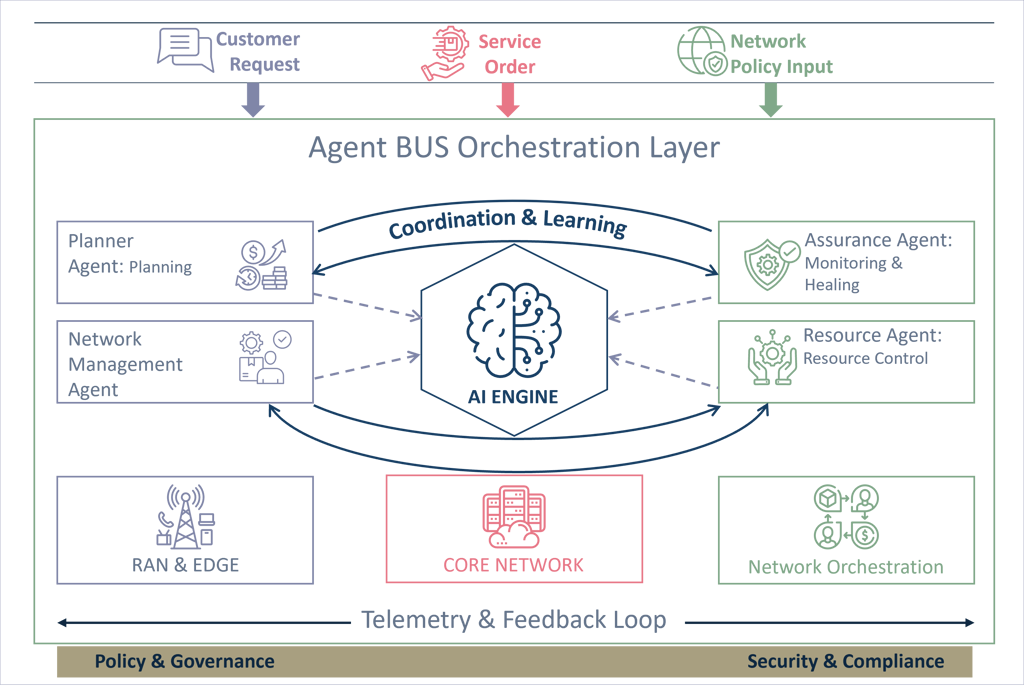
Control loops become adaptive rather than rigid. Agents continuously observe KPIs, performance trends, and system feedback. When an action fails, or conditions shift, the loop replans and retries. Loops placed closer to the network operate at a faster cadence, while higher level loops near customer facing systems run more slowly. This hierarchical closed loops allows networks to respond to events in real time while maintaining strategic alignment with business goals.
Agentic orchestration blends deterministic guardrails with probabilistic reasoning. High stakes actions—billing events, physical changes, regulatory sensitive operations—remain governed by strict policies. Dynamic triage, exception handling, and cross domain coordination are delegated to agents that can adapt to uncertainty. This hybrid model preserves safety while unlocking flexibility.
As deployments mature, agentic systems create continuous improvement cycle. Runtime insights feed back into agent capabilities. Agents learn from historical remediation patterns, topology changes, SLA outcomes, and customer experience metrics. Over time, the orchestration layer becomes better at predicting failures, selecting remediation strategies, and optimizing resource allocation.
The impact spans multiple domains. In fulfillment, agents translate service intents into resource level actions, coordinating provisioning across RAN, core, and edge. In assurance, sensing agents filter telemetry, triage agents localize issues, and configuration agents execute corrective actions—often before customers notice. In cross domain operations, agents reconcile inventory, resolve exceptions, and route tasks automatically to the right subsystem or human operator.
Early deployments typically begin as domain specific pilots: a self healing loop in transport, an intent driven provisioning engine for slicing, or an exception handling agent for configuration fallout. Over time, these evolve into multi domain fabrics capable of end to end orchestration.
Industry conversation often suggests that agentic orchestration is already widespread, but adoption remains uneven. Most operators are in early or partial implementation phases, experimenting with isolated agent loops rather than end to end autonomous orchestration. The transition is gradual: from monolithic orchestrators → to domain specific agents → to cross domain collaboration → to fully autonomous orchestration fabrics.
The industry is rapidly introducing agent based frameworks that modernize orchestration architectures. These platforms provide composable agent libraries, shared ontologies, distributed reasoning engines, and intent management layers. As agent ecosystems grow, governance becomes essential—clear definitions of agent roles, boundaries, escalation paths, and safety constraints guide autonomous behavior.
Agentic orchestration represents the most significant evolution in telecom operations since the introduction of closed loop automation. Multi agent systems replace rigid workflows with distributed intelligence, autonomous collaboration, and true intent driven execution across RAN, core, transport, and edge. Operators who adopt early—while maintaining architectural flexibility and strong governance—gain faster delivery, higher reliability, lower operational cost, and a realistic path toward autonomous networks. Agentic orchestration is not a trend; it is the natural evolution of network operations in an AI native, intent driven world.