

Quick Summary: “Scaling a telecom network well is a planning discipline, not a reaction to congestion. Five pillars, capacity forecasting, modular architecture, migration strategy, vendor alignment, and operational readiness, each head off a specific failure mode, from over-build to service-disrupting migrations.”
Most network-scaling problems are planning problems wearing a technical disguise. Operators are absorbing relentless data growth, new service classes, and shifting regulation all at once, and the ones who scale cleanly are not the ones with the biggest capex, they are the ones who planned. Scaling on purpose, rather than in reaction to congestion, is the discipline that separates controlled growth from expensive firefighting.
Strategic planning here is not traffic forecasting or upgrade budgeting in isolation; it is aligning technical capability with long-term business goals. A good plan makes scaling proactive instead of reactive, cost-controlled by avoiding both over-build and under-provisioning, and architecturally coherent with where the network is headed. Without that foresight, scaling fragments into redundant, poorly coordinated upgrades that degrade service rather than improve it.
Several forces are rewriting the scaling equation at once. 5G and 5G-Advanced (3GPP Rel-18+) push ultra-reliable low-latency communication (URLLC) and massive machine-type communication (mMTC), forcing a rethink of core and edge. Industrial IoT brings millions of sensors online that have to be connected scalably and securely. Cloud-native operation deepens integration with hyperscalers and demands flexible orchestration and dynamic resource allocation. And user behavior, real-time gaming, video conferencing, AR/VR, keeps breaking traditional capacity models. Planning is how operators get ahead of these instead of chasing them.
Regulation and sustainability now shape how networks scale, not just how fast. Governments and industry bodies increasingly expect energy-efficient infrastructure and carbon-conscious deployment, which pulls environmental impact assessment, green-technology adoption, and lifecycle optimization into the plan. Scaling decisions now carry a performance-versus-sustainability trade-off that has to be made deliberately rather than discovered later.
Five pillars carry a credible scaling plan. Capacity forecasting: predictive modeling of traffic growth by region and service, with seasonal spikes, new applications, and regulatory shifts built in. Modular architecture: SDN, NFV, and increasingly cloud-native functions (CNFs) and disaggregation, so the network scales by incremental upgrade rather than forklift overhaul. Migration strategy: phased legacy-to-modern transitions with backward compatibility and redundancy to keep service up during the cutover. Vendor and technology alignment: open standards to limit lock-in, with procurement cycles synced to strategic milestones. Operational readiness: teams trained on the new technology and workflows, backed by monitoring and assurance that hold performance through the scale-out.
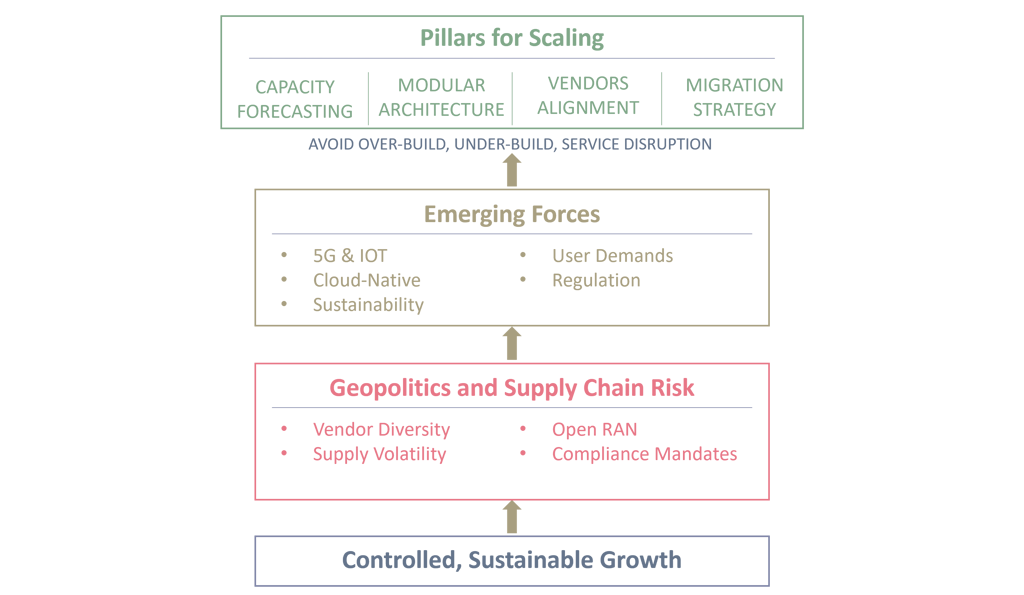
The pillars sit on top of a less comfortable reality: geopolitics and supply-chain volatility. Global events disrupt equipment availability, slip deployment dates, and reorder investment priorities, and for US operators, supply-chain security mandates (Section 889 and the rip-and-replace program) have made vendor diversity a compliance issue, not just a commercial one. Multi-vendor sourcing, Open RAN optionality, and explicit contingency planning in the roadmap are what keep momentum when the supply base wobbles.
The failure modes are well known. Over-scaling strands capital in capacity nobody uses; under-scaling invites congestion and churn. Fragmented planning (upgrades made in isolation, without cross-functional coordination) breeds inefficiency and misalignment. And planning only from the center, ignoring edge dynamics, misses the traffic surges that actually happen at the periphery. Each of these maps directly back to a pillar: the discipline is less about prediction and more about not skipping a pillar under deadline pressure.
The most expensive misalignment is between commercial and network strategy. When product teams launch services without synchronized infrastructure planning, the result is bottlenecks, missed SLAs, and reputational damage. Planning closes that gap by forcing the technical and business sides into the same room early, so scaling enables service innovation instead of throttling it.
5G is mainstream, but the planning horizon already includes 6G, with commercial service widely expected around 2030 (3GPP 6G study work is in Release 21), which means new spectrum bands, higher data rates, and tighter latency for AR and autonomous systems belong in today roadmap, not tomorrow. As operators shift from connectivity providers to digital-service enablers, the planning discipline becomes a competitive differentiator: it enables agile service rollout, efficient spectrum use, resilience under stress, and sustainable growth across geographies. Scaling without strategy is expansion without direction; scaling with it is evolution with purpose, and the operators who internalize that will spend less to grow more.