AI‑RAN: Turning the Industry’s Biggest Cost Center into Opportunity
The Paradox at the Heart of Mobile
10 Minute Read

The mobile industry has a structural contradiction it cannot ignore. Demand for data has never been higher, yet revenue per bit keeps falling. Operators spend roughly 45–50% of their capital expenditure on the Radio Access Network (RAN) — the single largest cost line in the business — and for decades that investment has yielded exactly one return: connectivity. The RAN has been a cost center, full stop. AI-RAN changes that equation. Not by replacing the RAN, but by changing what the RAN can do. The AI-RAN Alliance now counts more than 130 members, commercial deployments are live, and most operators surveyed expect shared AI-RAN deployments well before the 2030 6G timeframe. This is no longer a roadmap conversation; it is happening now.
Before listing what AI-RAN can do, we have to answer the question every CFO will eventually ask: we already have automation, edge computing, and self-organizing networks — so what does AI-RAN actually change? The answer mirrors the Starbucks story. Coffee already existed. What changed was the business model built around it. Operators already own the towers, the spectrum, the fiber, and the real estate. AI-RAN gives them the intelligence to stop managing a cost line and start operating a platform. It is not just coffee — it is Starbucks.
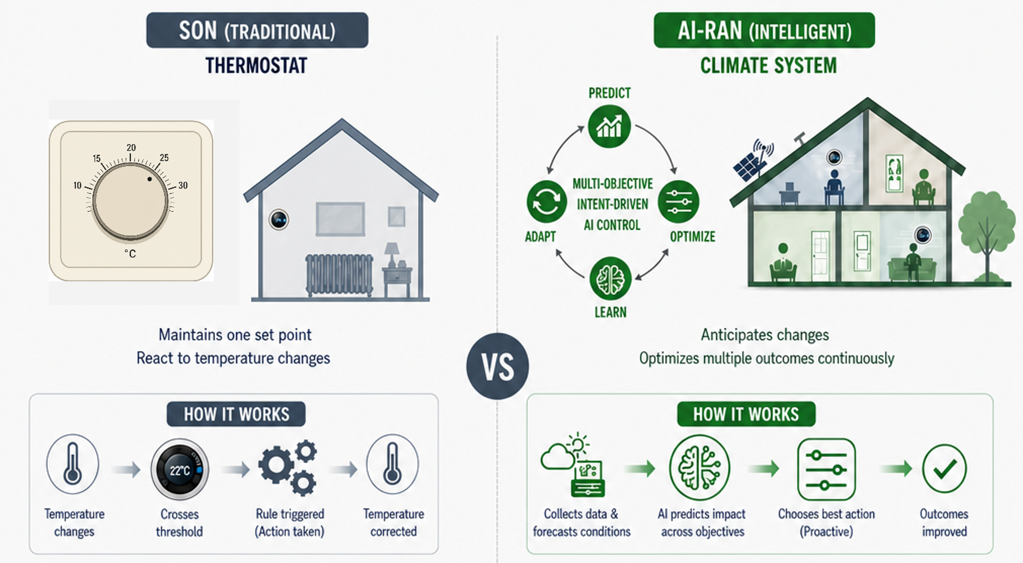
Self-Organizing Networks (SON) have existed since 3GPP Release 8 in 2008. They follow rigid, rule-based logic: if a signal metric crosses a threshold, execute a predefined action. They optimize one KPI at a time and react after the fact. AI-RAN replaces that with learning models that predict, adapt, and simultaneously optimize across multiple competing objectives — the difference between a thermostat and a climate system that knows it will rain on Thursday and pre-adjusts accordingly. SON is reactive by design; AI-RAN is anticipatory by design.
ETSI Multi-access Edge Computing (MEC) promised compute power at the network edge for years, yet monetization stalled because edge servers sat alongside the network rather than within it. AI-RAN dissolves that separation. When RAN processing and AI inference share the same GPU hardware, compute utilization moves from roughly 33% toward near-100%. The infrastructure operators already own becomes the edge compute platform — not "build it, and they will come," but "what you already built is the platform."
Traditional energy-saving features operate on fixed time schedules, indifferent to actual traffic. AI-RAN learns granular, site-specific traffic patterns and makes dynamic decisions per carrier, per cell, and per time slot. Because the RAN accounts for roughly 70–80% of a telco's total energy bill, this distinction carries enormous financial weight. AI-driven optimization — including intelligent deep-sleep modes — has been reported to reduce radio power consumption by 15–30%, translating to tens of millions of dollars in annual savings at scale.
Today's RAN runs on purpose-built ASICs and FPGAs designed to do one thing. When traffic is low, that hardware sits idle. AI-RAN shifts the architecture toward flexible, software-defined infrastructure on commercial off-the-shelf servers and GPUs, reducing both CAPEX and OPEX while enabling the same hardware to run AI workloads during idle network periods. Early field tests have reported AI-based systems delivering on the order of 20% higher throughput and 10% greater spectral efficiency versus traditional methods — capacity gains that defer expensive new site deployments and spectrum acquisitions. Perhaps the most profound shift is the reimagination of the cell site itself. For decades, the site was passive infrastructure: steel, antennas, and a lease agreement. AI-RAN turns it into a distributed AI compute node capable of hosting edge inference, sensing services, and AI workloads for industries far beyond connectivity. That is the Starbucks shift — same raw ingredient, entirely different business model built around it.
Reactive, Rule-Based Automation vs. Predictive Multi-Objective Intelligence:
Where the Value Is Created Category A — AI-for-RAN: Making the Network Smarter The most immediate and lowest-risk value comes from using AI to optimize the RAN itself. AI-driven energy management deployed by a major Asian operator across roughly 8,000 sites has been reported to deliver 14–15% average energy savings, with peaks above 20% during off-peak hours — at scale, tens of millions of dollars in annual savings. Separately, a leading North American carrier's multi-vendor RIC deployment has reportedly achieved 15% average energy savings and up to 35% per sector, confirming AI-driven energy optimization as one of the fastest-payback investments in the operator toolkit. AI-powered channel estimation uses neural-network models to predict channel state more accurately than conventional pilot-based methods, reducing overhead while improving throughput — gains that translate directly into deferred site deployment. Intelligent beam management predicts optimal beam patterns in real time rather than reacting to interference after it occurs, improving spectral efficiency in dense urban environments and extending the useful life of existing deployments before costly densification is required.
AI-enhanced handover optimization anticipates user movement and pre-selects target cells before signal quality degrades, eliminating dropped calls and ping-pong handovers — reducing churn and complaint-driven OPEX. AI-driven traffic prediction pre-empts congestion by dynamically redistributing load across spectrum bands ahead of demand peaks, allowing operators to meet SLAs without chronic over-provisioning. Predictive maintenance analyzes equipment sensor data and KPI trends to identify failures before they occur; each avoided field visit saves $500–$1,500, and reducing unplanned downtime by 30% across thousands of sites delivers compounding operational savings. Underpinning all of this is the O-RAN RAN Intelligent Controller (RIC), the programmable AI layer that enables real-time xApps for mobility and interference management alongside longer-horizon rApps for energy, SON, and traffic optimization — and that breaks vendor lock-in in the process.
Category B — AI-and-RAN: Shared Infrastructure The medium-term convergence play centers on running RAN processing and AI inference on shared GPU-based compute. A major Japanese operator's field trial demonstrated a fully software-defined RAN on GPU hardware achieving 16-layer MU-MIMO downlink — roughly 3x the spectral efficiency of a conventional 4-layer system — while the same hardware simultaneously hosted AI inference workloads, pushing compute utilization toward near-100%. That creates a dual-revenue asset from infrastructure already paid for, fundamentally changing the economics of RAN investment. Software-defined Massive MIMO replaces fixed-function hardware stacks with software running on general-purpose GPUs, enabling new features to be deployed over the air rather than through hardware replacement cycles. AI-driven orchestration manages the dynamic allocation of compute between RAN and AI workloads in real time, eliminating static resource partitioning and maximizing return on every GPU cycle. Meanwhile, Integrated Sensing and Communications (ISAC) — a 3GPP study item in Release 19, with normative work expected in Release 20 — enables the same radio signals that carry data to simultaneously sense the environment, detecting drones and tracking objects with no additional hardware. A leading European vendor has demonstrated live UAV detection using commercial massive-MIMO infrastructure, establishing sensing-as-a-service as a candidate revenue stream from already-deployed assets.
Category C — AI-on-RAN: The Edge Monetization Play The largest revenue opportunity transforms the RAN from cost center to profit center. Operators collectively run on the order of 100,000 distributed central offices, edge sites, and mobile switching offices worldwide, with significant aggregate spare power and compute capacity — the foundation of what is now being called the AI Grid. Multiple major operators announced AI Grid initiatives in early 2026, with edge AI infrastructure being piloted at cell sites and mobile switching offices. Vision AI agents for public safety, municipal operations, and industrial monitoring are being assessed by city governments, establishing a B2G revenue model built on existing telecom real estate. Early operator estimates suggest AI-RAN infrastructure investment can yield ROI well above 100%, though those numbers depend heavily on use-case mix and edge utilization. Low-latency edge services let autonomous vehicles offload visual processing and contextual reasoning to the network, reducing on-vehicle compute requirements while improving safety. Smart-factory deployments combine private 5G with edge AI for real-time quality inspection, robotic coordination, and digital-twin synchronization — applications that command premium enterprise pricing well above consumer connectivity margins. AR/VR, personal AI assistants, and healthcare monitoring all need the sub-35 ms latency and always-on responsiveness that only edge-distributed inference can provide. The "Inference Tsunami" is already arriving: as AI workloads proliferate, networks must handle trillions of inferences at the edge daily — and operators are uniquely positioned to serve that demand.
Category D — Operational Transformation AI is also transforming how operators build and run networks. Agentic AI approaches — where AI models interpret operator intent and manage network behavior autonomously — are moving from research toward early deployment, advancing the industry toward TM Forum Level 4 and Level 5 network autonomy. Automated fault detection and root-cause analysis compress hours of manual troubleshooting into seconds by correlating alarms, KPIs, and environmental data across thousands of sites simultaneously. AI-driven network planning replaces months-long manual cycles with continuous, data-driven optimization — accelerating time-to-market for new coverage and improving CAPEX allocation precision.
The Road Ahead AI-RAN is the foundational technology for 6G, which is being designed as AI-native from the ground up — making today's investments directly applicable to the next generation of networks. The AI-RAN Alliance's 130+ members are building the common framework and open interfaces that will define this architecture globally, ensuring compatibility and accelerating ecosystem innovation. There is also a geopolitical dimension that operators and governments increasingly recognize: the nations and operators that build AI-native networks first will set the standards others follow — a competitive and strategic advantage that compounds over time. The operators who move now are not just improving their networks — they are repositioning their entire business. The towers are built. The spectrum is licensed. The infrastructure is in place. The question is no longer whether to invest in AI-RAN. The question is how quickly operators can move before the window of competitive differentiation closes.