Autonomous RAN Optimization: From SON to Agentic RAN
Agentic RAN is the leap from automation to true autonomy
7 Minute Read

For more than a decade, Self-Organizing Networks (SON) have been the automation backbone of mobile networks. But SON was built for a world of predictable traffic, static topologies, and limited cross-domain coordination. As 5G-Advanced and 6G introduce massive RAN (Radio Access Network) complexity — multiband, multilayer, multivendor, AI-native architectures — rule-based SON is no longer enough.
Agentic RAN represents the next evolutionary step: autonomous, goal-driven software agents that perceive, reason, act, and learn across the RAN with minimal human intervention. Instead of executing predefined SON functions, agentic systems pursue operator-defined intents — such as maximize cell-edge throughput, minimize energy per bit, or guarantee SLA for enterprise slices — and dynamically choose the optimal sequence of actions to achieve them. Tracing the evolution from SON to Agentic RAN requires exploring how agentic frameworks, natural-language intent processing, collaborative multi-agent systems, and AI-native RAN factories collectively enable higher levels of autonomy in 5G-Advanced and 6G networks.
Traditional SON frameworks such as ANR (Automatic Neighbor Relations), MLB (Mobility Load Balancing), MRO (Mobility Robustness Optimization), CCO (Coverage and Capacity Optimization), and PCI optimization — standardized in 3GPP TS 32.500 / TS 36.902 — were designed for a much simpler RAN environment. They relied on deterministic rules, operated within localized scopes, executed periodically, had limited cross-vendor visibility, and pursued static optimization objectives. This approach worked well in the LTE era, when traffic patterns were predictable, and overall RAN complexity remained manageable. As networks evolved, however, the assumptions behind SON began to break down.
With 5G-Advanced, the RAN has become significantly more complex. Massive MIMO introduces hundreds of beamforming parameters, deployments now span multiple bands and layers, and features like carrier aggregation and dual connectivity add further dynamism. Network slicing brings per-slice SLAs, while cloud-native, disaggregated architectures such as vRAN and O-RAN reshape how functions are deployed and controlled. Real-time RIC control loops over the E2 interface demand millisecond-scale responsiveness. In this environment, rule-based SON cannot adapt quickly enough to changing conditions, cannot coordinate across RAN, transport, and core, cannot optimize for conflicting objectives, cannot learn from outcomes, and cannot operate at the speed modern networks require. The industry now needs automation that is adaptive, contextual, predictive, and fundamentally goal-driven.
Agentic RAN introduces a new paradigm built on autonomous, collaborative agents that perceive, reason, and act across the network. These agents continuously ingest RAN KPIs and counters, beam-level measurements, UE telemetry, transport and core KPIs, environmental and geospatial data, and predictive models related to traffic, mobility, weather, and interference. This creates real-time situational awareness far beyond what traditional SON could achieve. Instead of following static rules, agents evaluate operator intents, predict the impact of actions, run multistep optimization plans, resolve conflicts between objectives, and coordinate with other agents. LLM-powered agents enhance this reasoning layer by interpreting natural-language intents and translating them into actionable, multistep tasks. Once decisions are made, agents directly modify beamforming weights, power allocation, tilt and azimuth, MCS and link adaptation thresholds, carrier aggregation and dual connectivity policies, slice resource partitions, and energy-saving modes. These actions are executed through Near-RT RIC xApps, Non-RT RIC rApps, and cloud-native RAN orchestration APIs.
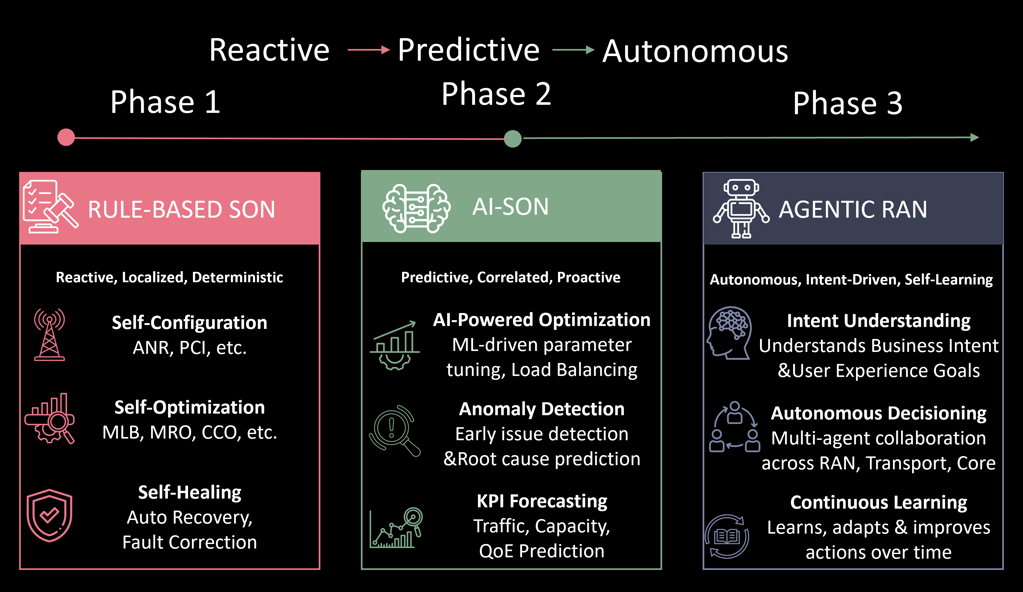
The evolution from SON to Agentic RAN has unfolded in three phases. The first phase, rule-based SON, relied on predefined functions, localized optimizations, limited coordination, and reactive behavior. The second phase, AI-SON (or ML-augmented SON), introduced ML-based anomaly detection, predictive load balancing, KPI forecasting, and improved parameter tuning, but still required humans to define workflows. The third phase, Agentic RAN, represents true autonomy: agents understand operator intent, plan multistep optimization sequences, coordinate across domains, learn from outcomes, and operate continuously and proactively. This marks the shift from automation to autonomy — aligning with TM Forum's Autonomous Networks Level 4 (high autonomy) on the path to Level 5 (full autonomy), per IG1230 / TR-178.
In the agentic architecture, operators express high-level goals such as guaranteeing 50 Mbps cell-edge throughput for an enterprise slice, minimizing energy consumption during off-peak hours, or maximizing spectral efficiency during large events. LLMs translate these intents into machine-interpretable objectives. A distributed multi-agent system then takes over, with specialized agents for coverage, capacity, interference, energy, slice SLA management, and transport-aware optimization. These agents collaborate through shared policies, unified telemetry, and hierarchical control loops. Supporting this is the AI-RAN Factory — an automated, self-retraining pipeline that observes agent interactions, generates improved agents, continuously optimizes policies, and enables Level-4/5 autonomy. Execution occurs across multiple timescales through Near-RT RIC loops (10 ms - 1 s, per O-RAN.WG3), Non-RT RIC loops (>1 s, per O-RAN.WG2), and cloud-native orchestration, forming a stable, multilayered control hierarchy.
Real-world applications of Agentic RAN demonstrate its impact. In autonomous beam optimization, agents adjust beams based on UE mobility, interference maps, weather, and traffic density, with reported 15–25% improvements in cell-edge throughput. Slice-aware optimization dynamically tunes PRB allocation, scheduling weights, QoS flows, and CA/DC policies to ensure deterministic performance for enterprise and URLLC slices. Energy-aware optimization allows agents to switch off carriers, reconfigure MIMO layers, and optimize power allocation, achieving 10–20% energy savings without degrading QoE. Transport-aware optimization enables agents to coordinate RAN actions with transport congestion predictions, reducing SLA violations and improving user experience. The benefits of the agentic approach are substantial. Vendor-reported studies show up to 17% higher throughput in interference optimization, up to 67% higher QoS satisfaction through improved intent recognition, and significant reductions in stress-induced outages compared to traditional systems. Operators report 80% reductions in analysis time, 25% faster time-to-repair, 50–67% lower deployment effort, and 70–90% reduction in day-to-day operational tasks. Engineer productivity is reported to increase by up to 600%, and data storage costs drop by around 30%.
Industry momentum is accelerating rapidly, with mature implementations emerging across major network vendors, cloud platforms, and automation providers. Key trends include natural-language interfaces such as "Talk to Network," alignment with O-RAN R1/O1 interfaces and 3GPP NSMF (Network Slice Management Function) / NSSMF (Network Slice Subnet Management Function) per TS 28.531/28.532, the rise of high-quality multidomain data pipelines, hybrid human-AI operational models, and localized deployments that support sovereignty and low-latency control.
To prepare for Agentic RAN, operators are beginning to consolidate telemetry across RAN, transport, and core; deploy RIC platforms with open APIs; introduce ML-based forecasting models; define intent taxonomies; and run agentic pilots in high-value clusters. The transition is incremental, but the transformation it enables is profound. SON was the first step toward automation, but it was never designed for the complexity of 5G-Advanced and 6G. Agentic RAN represents a fundamental shift: from rule-based functions to autonomous, goal-driven agents capable of perceiving, reasoning, acting, and learning across the entire RAN. This is the architecture that will power the next decade of mobile networks — adaptive, intelligent, and relentlessly optimized for operator intent.