Balancing Density and Interference: Modeling the Path of Intelligent RANs
Interference, spatial reuse, and AI modeling for future RANs
6 Minute Read
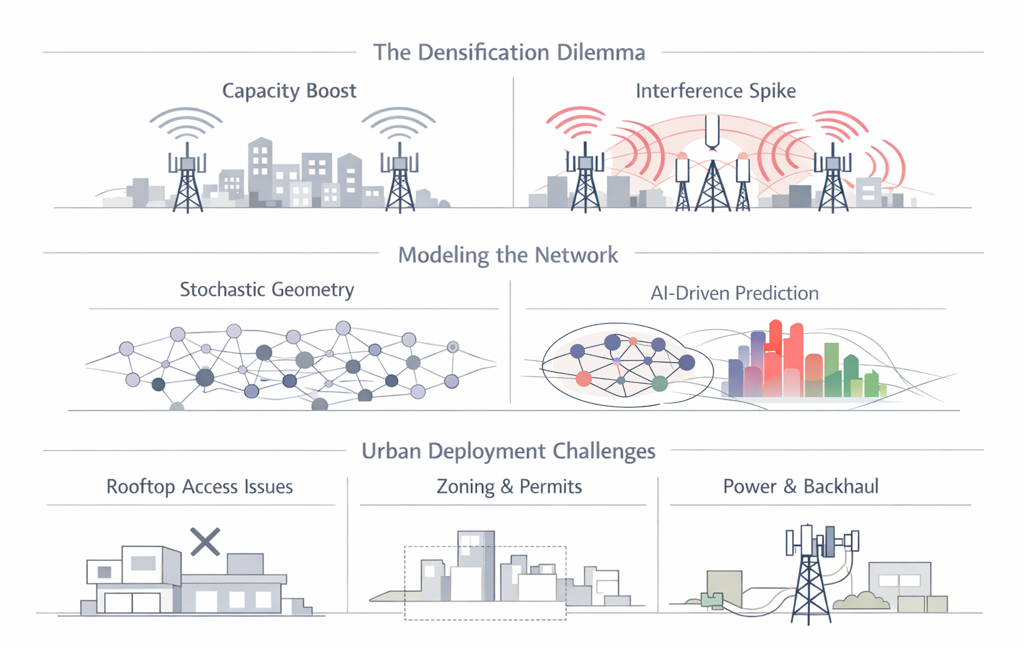
Every operator accelerating toward ultra-dense 5G, 5G-Advanced, and early 6G architectures faces the same shift: densification is no longer a coverage tactic but a capacity-driven necessity. The central challenge is not whether to densify but how to densify intelligently, because every new small cell or mmWave radio introduces another layer of interference. Conventional planning methods struggle with the multiscale, dynamic behavior of dense networks, and the future of RAN performance will depend on how effectively operators can model, predict, and manage interference in increasingly crowded topologies using AI-driven modeling.
Densification improves spectral reuse and boosts user throughput, but it also compresses inter-site distances to the point where traditional interference assumptions break down. Even with massive MIMO, beamforming, dynamic TDD, and spectrum sharing, the physics remain unchanged: more transmitters in closer proximity create more opportunities for signal overlap. Interference modeling, therefore, becomes a strategic discipline, requiring operators to understand not only how interference behaves today but how it will evolve as density scales across urban grids, enterprise campuses, and indoor hotspots, particularly in mmWave and future sub-THz bands. Beyond the technical challenges, operators face an equally demanding physical reality: finding viable places to put new radios. In dense urban environments, rooftop availability is limited, building owners negotiate aggressively, and zoning restrictions often prohibit new structures. Even when a site is approved, operators must secure power, fiber backhaul, and safe installation access, each of which can delay deployment by months. These constraints mean that densification is not just an RF engineering problem but an urban infrastructure and economic one. The most accurate interference model is only as useful as the operator's ability to secure the physical footprint required to execute it, making site acquisition feasibility an essential part of intelligent densification.
To understand and predict interference behavior in these environments, modern RAN modeling blends analytical rigor with machine learning intelligence. Techniques such as stochastic geometry, Poisson Point Process modeling, and spatial statistics quantify how cell density affects SINR distributions and reveal the density tipping point — the moment when adding more cells stops improving throughput and begins degrading it. These analytical foundations also help quantify interference in scenarios involving non-orthogonal signaling, dynamic TDD, heterogeneous deployments, user-to-user interference, and mmWave blockage patterns. However, traditional reduced-order modeling cannot capture the full complexity of ultra-dense networks, which is why AI-enhanced prediction has become indispensable. AI models learn real-world interference behavior from telemetry, including cross-cell power interactions, beam collision patterns, mobility-driven interference spikes, time-of-day traffic-induced SINR shifts, and dynamic user scheduling behavior. This enables real-time optimization through AI-based beamforming, predictive scheduling, and interference-aware resource allocation.
Digital twins extend this intelligence by simulating thousands of deployment scenarios before a single site is built. They integrate RF propagation, traffic patterns, mobility flows, interference fields, energy consumption, and site acquisition constraints, reducing planning risk and CAPEX waste. Cloud RAN architectures further enhance interference coordination by centralizing baseband processing, enabling coordinated multipoint transmission and reception (CoMP), and allowing the network to treat interference as a controllable variable rather than an unavoidable byproduct. Looking ahead to 6G, reconfigurable intelligent surfaces (RIS) offer a method to redirect signals around obstacles, improve SNR, and reduce the need for high transmission power in dense mmWave networks, especially where physical densification is constrained.
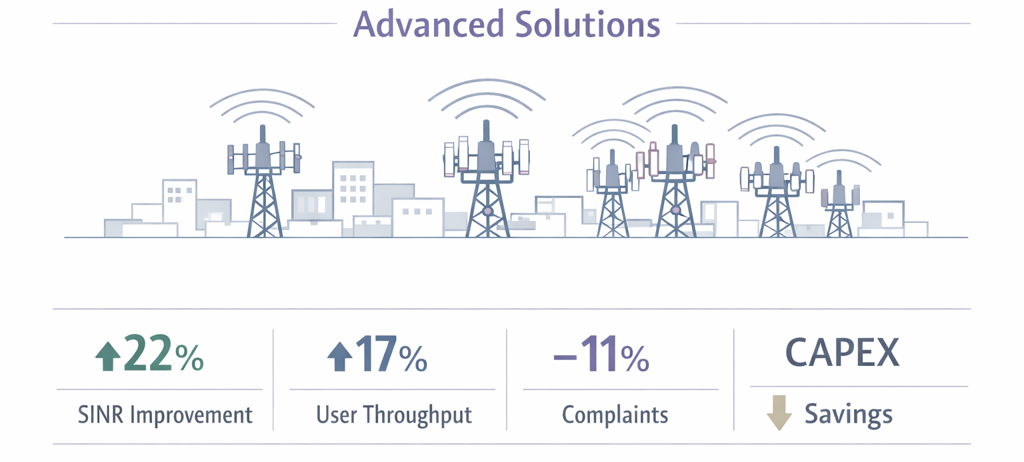
A recent Tier-1 operator deployment in Southeast Asia illustrates the importance of interference-aware densification. After rolling out a dense grid of small cells across a high-traffic business district, the operator initially saw strong performance gains, but within months SINR degradation emerged during peak hours. Traditional optimization — tilt changes, power adjustments, and beam refinements — offered only marginal improvements. The operator then introduced an AI-driven interference modeling platform capable of forecasting interference hotspots 24 hours in advance, identifying small cells placed too close to macro beams, and autonomously adjusting power levels. These capabilities produced a 22 percent improvement in median SINR, a 17 percent increase in user throughput, an 11 percent reduction in customer complaints, and significant CAPEX savings by avoiding unnecessary new sites. The case demonstrates that densification alone does not guarantee performance; only interference-aware densification does.
Accurate interference modeling gives operators several concrete levers: optimizing site placement before deployment; tuning power, tilt, and beam patterns with precision; identifying zones where densification will deliver real gains; avoiding overbuild where returns diminish; and cutting rollout delays and post-deployment troubleshooting. It also supports more efficient resource coordination through centralized architectures and reduces energy consumption through intelligent scheduling and power control. In dense urban grids, where interference is the primary bottleneck, predictive modeling is the difference between a high-capacity network and a congested one.
As networks become more dynamic, with traffic patterns shifting hourly and spectrum allocations changing in real time, static planning is no longer sufficient. AI-driven interference prediction enables networks to autonomously adjust power levels, beam patterns, scheduling decisions, frequency reuse strategies, RIS configurations, and energy-saving modes. This transforms interference management from a reactive process into a continuous, self-optimizing function. In the long term, interference-aware densification will be foundational for zero-touch RAN operations and 6G-class autonomy. Operators that treat interference modeling as a strategic capability will realize the full value of densification, while those relying on traditional planning assumptions will face escalating noise, unpredictable SINR, and rising operational complexity. As the industry moves toward AI-native architectures, the ability to model and manage interference at scale will define the next generation of intelligent RANs. Densification is inevitable; intelligent densification is a choice.