Customer Assurance Across the Control and User Planes (CP/UP)
Converged Visibility for Experience-Centric Ops
5 Minute Read
TL;DR: Customer-experience problems usually live in the gap between the control plane and user plane. Converged CP/UP assurance correlates signaling with data-path telemetry, verifies that control intent is actually executed, and closes the loop. Separation (CUPS) still wins tactically for edge scale and isolation; the right model is hybrid.
Assuring customer experience in a dynamic, intent-driven network means watching the control plane (CP) and user plane (UP) together. The two layers have long been managed separately; the case for a converged lens — unified visibility, coordination, optimization — is that experience problems usually live in the gap between them. The control plane and user plane serve distinct but interdependent roles. The control plane is the "brain" — signaling, session setup, policy enforcement, mobility. The user plane is the "muscle" — forwarding the actual data (voice, video, internet) across access, transport, and core. The control plane decides how traffic should flow; the user plane executes what flows. When the two operate in isolation, fragmentation creeps in: misaligned policies, delayed responses, and a degraded customer experience.
Telecom environments span multiple domains — RAN, transport, core, and cloud — each with its own CP and UP implementation. Separation buys architectural flexibility but adds operational complexity. Misconfigured control policies or congested user paths cause latency and jitter; discrepancies between control intent and user execution cause policy drift and inconsistent QoS enforcement (the policy itself is set by the PCF in 5G, the PCRF in 4G). Troubleshooting gets harder when a fault in one plane is invisible in the other. And while decoupling can contain threats, it requires distinct, well-coordinated security for each plane.
Convergence is what moves operations from reactive fault monitoring to proactive experience management. A unified assurance model aligns telemetry across signaling flows and data paths, making it possible to correlate performance with policy enforcement. Mapping control sessions to user traffic gives session-aware analytics — granular insight into service behavior and anomalies — and supports intent verification: confirming that a control-plane decision (slice selection, QoS profile) is actually executed in the user plane. Modern assurance platforms increasingly use AI/ML to detect divergence between control intent and user behavior, feeding closed-loop optimization (the pattern ETSI ZSM standardizes, with NWDAF as the 5G-core analytics source).
Cross-plane visibility unlocks operational use cases that touch experience directly. Slice lifecycle management confirms that control-plane slice definitions (S-NSSAI) are reflected in user-plane isolation and performance. Streaming optimization improves video by correlating policy enforcement with throughput and buffering. Roaming and handover benefit from synchronized tracking of signaling events and data continuity, cutting disruptions. Security enforcement is stronger when firewalls and packet filters are verified to operate in sync across both planes.
Convergence takes architectural alignment. Integrated probes and agents across RAN, transport, and core capture both signaling and payload. A centralized analytics engine correlates multi-domain telemetry and applies ML for anomaly detection. API-driven interfaces move data in real time between OSS/BSS, SDN controllers, and assurance platforms. And the whole thing has to scale and stay resilient under high-volume ingestion and shifting network conditions.
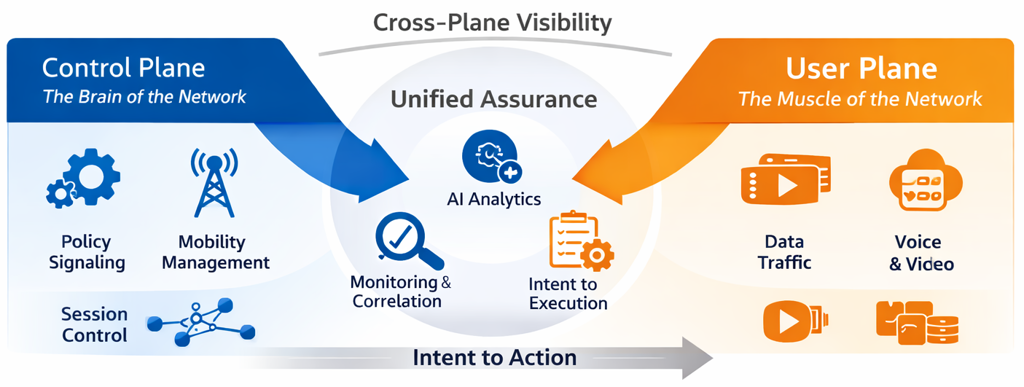
While convergence is the strategic goal, separation has tactical value when applied deliberately. Control and User Plane Separation (CUPS) — standardized for the 4G core in 3GPP Release 14 (TS 23.214), and native to the 5G core as the SMF/UPF split over N4/PFCP — lets operators scale user-plane capacity in high-traffic spots (stadiums, venues) without over-provisioning the control plane. Pushing user-plane functions (UPF) closer to users, at the edge or via MEC, supports low-latency services such as AR, autonomous vehicles, and gaming. And isolating the planes contains threats and keeps disruptions from spreading.
Customer-support teams gain the most from unified cross-plane visibility. A 360-degree view of service history — control-plane signaling plus user-plane performance — shortens resolution time and lifts satisfaction. AI-guided troubleshooting can localize a root cause, whether a config error or congestion. And analytics-driven alerts enable proactive customer communication, managing expectations and cutting inbound calls during disruptions.
The strongest play is a hybrid one: converge CP and UP assurance for unified visibility and consistent delivery, and apply separation where it improves agility, scalability, or resilience. As networks get more dynamic and intent-driven, that balance is less a technical nicety than a requirement for consistent experience. The concrete next step is narrow: instrument one experience-critical journey end to end across both planes — a slice, a roaming flow, or a high-density venue — verify control intent against user-plane execution, and close one loop before generalizing.