Enterprise Wireless in Transition
Wi-Fi 7, Wi-Fi 8, and the Limits of Private 5G
6 Minute Read

Quick Summary: “Wi-Fi 7 (802.11be) and Wi-Fi 8 (802.11bn / UHR) keep the enterprise LAN Wi-Fi-first; private 5G stays a specialized complement for outdoor mobility and industrial OT. The practical move is to refresh to Wi-Fi 7 now and scope private 5G to the use cases that justify its cost.”
Enterprise wireless is in a refresh-planning bind. For more than two decades, Wi-Fi (IEEE 802.11) has been the default indoor access technology for offices and campuses, while cellular has owned wide-area mobility. Now Wi-Fi 7 (802.11be), the early momentum behind Wi-Fi 8 (802.11bn), and the ongoing push for private 5G have muddied the next refresh cycle.
The question is no longer “Wi-Fi or 5G?” The answer is increasingly AND, not OR — a layered architecture where each technology plays to its strengths. Despite the hype around private 5G, the enterprise landscape remains overwhelmingly Wi-Fi-centric. Most organizations prioritize predictable performance, manageable cost, and operational simplicity — and Wi-Fi delivers those, while private 5G adds layers of complexity: spectrum access, specialized hardware, IT/OT integration, and ongoing operational overhead.
At the same time, expectations are rising. Hybrid work, real-time collaboration, automation, AR/VR, and high-density environments push wireless harder than ever. That is the backdrop against which Wi-Fi 7, Wi-Fi 8, and private 5G have to be evaluated.
Wi-Fi 7 (IEEE 802.11be) is the biggest performance step in the Wi-Fi family in over a decade. Its defining features — 320 MHz channels, Multi-Link Operation (MLO), 4096-QAM (4K-QAM), and lower latency — map directly onto modern enterprise needs. In practice it lifts performance in high-density offices, campuses, and auditoriums, while MLO adds reliability for real-time applications such as video conferencing, AR/VR, and robotics. Operation in the 6 GHz band cuts interference and congestion, and Wi-Fi keeps its hallmark advantages: low cost, no licensing, no specialized core, and simple deployment, plus near-fiber indoor speeds and better spectrum efficiency. The trade-off is real — Wi-Fi 7 still lacks the scheduled determinism of cellular, and real-world results depend on client support — but for most enterprises it is a clear, cost-effective upgrade.
If Wi-Fi 7 is about raw performance, Wi-Fi 8 (IEEE 802.11bn, branded Ultra High Reliability, or UHR) is about consistency. Notably, it does not chase higher peak PHY rates; its goal is reliability and bounded latency. It introduces multi-AP coordination — access points operating as one system rather than independent radios — so coordinated scheduling reduces interference and tightens worst-case latency, approaching the predictability traditionally associated with cellular (vendors are layering ML-based optimization on top, though that is implementation, not standard). That bounded-latency behavior is what makes industrial IoT, automation, and other latency-sensitive applications viable on Wi-Fi, and the economics stay enterprise-friendly. Wi-Fi 8 also forms the foundation for a unified indoor fabric that complements private 5G in outdoor and mobility-heavy environments. By closing Wi-Fi's historical reliability gap without private-cellular cost or operational burden, Wi-Fi 8 pushes many organizations even further toward a Wi-Fi-first strategy.
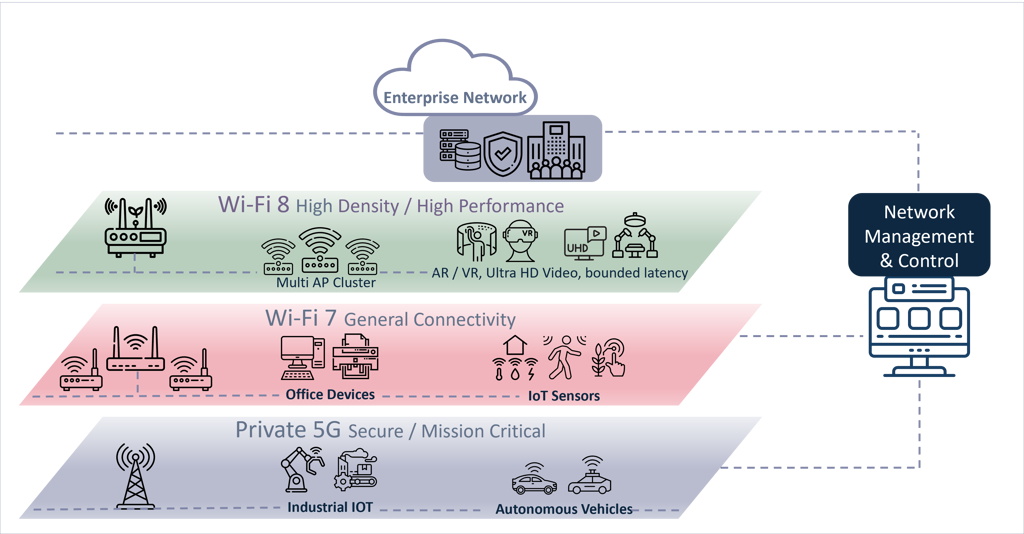
Private 5G brings real strengths: mobility across large outdoor areas, strong QoS, scheduled (deterministic) air-interface behavior via URLLC (3GPP Release 16), and reliability suited to mission-critical OT. It excels at large industrial sites — ports, mines, logistics yards — and supports automated guided vehicles, mobile robots, and harsh-RF deployments where Wi-Fi struggles. Guaranteed QoS, network slicing, bounded latency, and high availability make it uniquely valuable there. But the limitations are significant: high deployment and operating cost, spectrum-licensing and regulatory hurdles, a smaller device ecosystem than Wi-Fi, and complex integration with enterprise IT and security. For most indoor environments it is overkill. Private 5G is not replacing Wi-Fi; it is becoming a specialized complement for cases where mobility, determinism, and ruggedness outweigh cost and complexity.
The next decade will not be defined by one technology winning, but by layered adoption — a unified fabric in which Wi-Fi and private 5G coexist under shared identity, policy, and traffic-steering frameworks. Through 2024-2026, Wi-Fi 7 becomes the default refresh as enterprises upgrade on normal lifecycle cycles, while private 5G stays niche and largely confined to industrial verticals, and hybrid Wi-Fi/5G pilots grow but stay limited. As Wi-Fi 8 reaches the market later this decade, multi-AP coordination reduces the need for private 5G indoors and enables bounded-latency Wi-Fi for industrial use cases, even as private 5G keeps expanding in logistics, manufacturing, and outdoor OT. In this phase, AI and edge intelligence begin orchestrating both Wi-Fi and 5G, improving traffic steering and reliability. By 2030 and beyond, enterprises move toward fully unified architectures with common identity, policy, and security frameworks: a true indoor-outdoor fabric enabling seamless mobility, with Wi-Fi anchoring the LAN, private 5G handling specialized OT mobility, and wireless becoming a strategic architectural layer rather than a technology choice.
Each technology wins in a different environment. Wi-Fi 7 fits offices, campuses, and high-density indoor spaces — collaboration, conferencing, AR/VR, and general connectivity. Wi-Fi 8 extends that into large campuses and industrial indoor environments, enabling real-time applications, automation, and use cases that need bounded latency. Private 5G excels in outdoor mobility and large industrial sites, thriving in harsh RF and carrying mission-critical OT workloads such as robotics and autonomous systems.
Enterprise wireless is not a contest between Wi-Fi and private 5G. It is a transition to a hybrid, layered architecture where each technology plays to its strengths: Wi-Fi 7 and Wi-Fi 8 anchor the enterprise LAN on performance, predictability, and cost; private 5G remains a powerful but specialized tool for mobility, determinism, and industrial-grade reliability. The practical next step is unglamorous: map your refresh cycle to Wi-Fi 7 now, and scope private 5G to the specific OT use cases — outdoor mobility, AGVs, harsh RF — that actually justify its cost, rather than buying it on principle. The future of enterprise wireless is not OR. It is AND.