Fixed Wireless Access: Telecom’s Agile Frontier for Broadband
Transforming Wireless Networks Into a Scalable Broadband Business
5 Minute Read

Global broadband demand keeps climbing, and Tier 1 NA operators have a new answer that doesn't require trenching. Fixed Wireless Access (FWA) reuses LTE and 5G capacity to deliver home and business broadband over the existing RAN - no fiber drop, no cable contractor, no permit cycle on the critical path. Across major North American operators, FWA has evolved from a rural fill solution into a national subscriber growth engine that is reshaping how networks are planned, deployed, and operated.
FWA delivers broadband to stationary locations using radio signals between a gNB (or eNB on LTE) and customer premises equipment (CPE). Unlike mobile broadband, FWA is engineered for a fixed install - same antenna, same sector, predictable propagation - which simplifies the capacity model. The bigger shift happens behind the scenes. Field teams move from heavy construction workflows to lightweight deployments. Care teams adopt playbooks for self-install, remote activation, and proactive support. NetOps shifts from fiber route planning to spectrum-aware capacity management on shared cells. Sales and marketing reposition broadband as a service that turns up in days, not a construction project. FWA is not just a new access technology - it introduces a new operating rhythm across the organization.
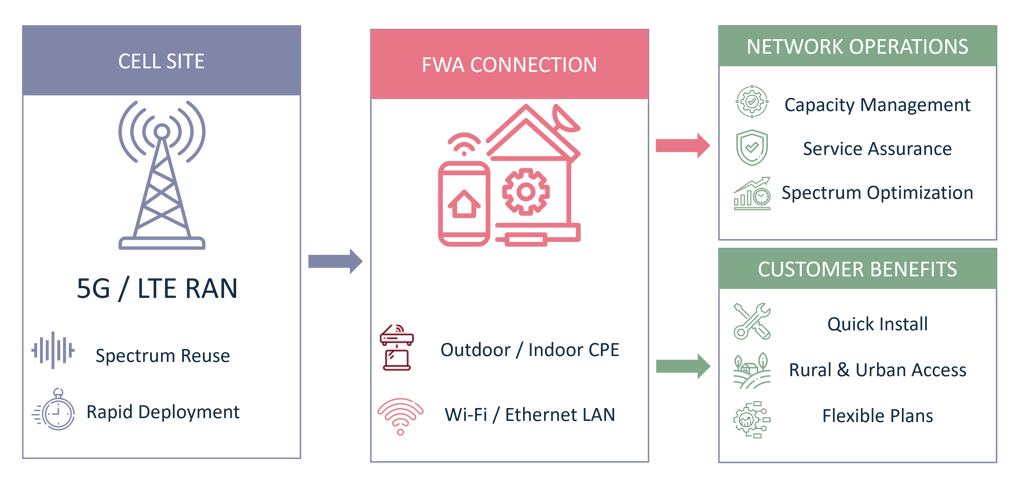
The architecture is straightforward: radio signals from a cell site reach an outdoor or indoor CPE at the customer location, which distributes connectivity via Wi-Fi or Ethernet to the home or office LAN. That simplicity translates into faster deployment cycles, fewer multi-vendor construction dependencies, and operational agility in markets where fiber timelines slip on permits or pole attachments. Self-install kits - now the default at some of the major american operators - shift the customer experience from a truck-roll appointment to an unboxing and app-guided activation.
FWA's cost advantage comes from reusing existing cellular infrastructure: incremental subscribers ride spectrum and sites the operator already owns. The financial case strengthens when paired with process modernization - lean deployment crews replace large construction teams, digital order-to-activation workflows eliminate permit-driven timelines, and operators can test markets dynamically before committing capital. Incremental scaling against real demand signals further reduces risk. The combination lowers barriers to entry, especially in rural or hard-to-reach areas where traditional builds are slow and expensive. The trade-off: every FWA subscriber consumes mobile capacity, so the cell-level economics only work where spectral headroom exists or can be added (mid-band C-band, 3.5 GHz CBRS, or millimeter wave). Beyond cost and speed, FWA unlocks new opportunities across the business. Market expansion teams enter underserved regions without waiting for fiber. Enterprise sales offer rapid turn-up connectivity for SMBs and multi-site campuses. NetOps gains a resilient secondary path for business continuity. Product teams differentiate through speed tiers, managed Wi-Fi, and bundled services. In competitive urban markets, FWA breaks cable monopolies and gives operators a third pipe to the home. U.S. enterprises increasingly adopt FWA where fiber is unavailable, slow to provision, or uneconomic. Major American operators are differentiating their FWA portfolios to serve this demand. Enterprise adoption, however, requires more than network capability. Solution architects design hybrid wired-wireless architectures; IT teams integrate FWA into SD-WAN and SASE overlays and cloud egress flows; support teams manage new performance expectations and SLAs that look different from MPLS or dedicated fiber. ABI Research projects that over half of global enterprise FWA subscriptions will originate from North America by 2030 - driven as much by operational readiness as by technology maturity.
In rural and remote communities, FWA is a pragmatic answer to the digital divide. Where fiber rollout is delayed or uneconomic, 5G FWA can deliver service within days, supporting access to education, healthcare, and economic opportunity. That requires local outreach to build trust, community partnerships to accelerate adoption, simplified onboarding for first-time broadband households, and support models tuned for non-technical users. Technology alone doesn't close the digital divide - people do.
FWA offers broad availability and high downlink speeds, though performance varies with network load, distance, and line-of-sight conditions. Foliage, weather, and building penetration affect signal quality; fiber remains more stable but is vulnerable to construction damage and aerial cuts. Operational teams must own line-of-sight assessment, congestion monitoring, spectrum-level capacity planning on shared cells, and customer education on CPE placement. Installation is fast and often self-service, but success depends on clear instructions, an intuitive activation app, and responsive support when the install doesn't go to plan.
FWA's constraints are real. Signal quality depends on line of sight to the serving sector; shared mobile bandwidth can degrade during peak hours; performance varies by cellular coverage; and CPE is fixed, not portable. These realities demand strong cross-functional coordination between RF engineering, care, field operations, and product - and a cell-loading policy that protects mobile subscribers when FWA traffic peaks.
With over 100 commercial 5G FWA deployments globally and Ericsson projecting 350 million FWA connections by 2030 - 80% over 5G - the technology is past pilot. For Tier 1 NA operators, FWA is not a stopgap. It is a scalable growth engine, a cost-efficient broadband strategy, a people-driven operational shift, a process-light deployment model, and a credible vehicle for digital inclusion. FWA is where 5G capacity, organizational design, and broadband economics converge - and the operators that win will treat it as all three.