
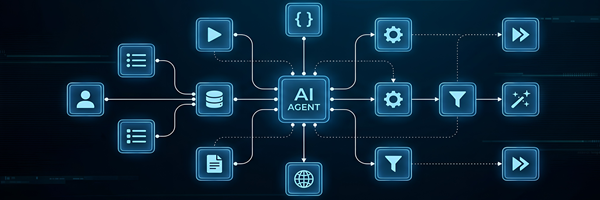
Quick Summary: “Agentic AI moves network operations from static, rule-based scripts to goal-seeking agents that plan, act, and adapt across domains — the TM Forum L3-L4 direction. The payoff is real but the readiness is not lights-out yet: start with one gated closed loop, instrumented against a manual baseline.”
Network operations is shifting from running scripts to supervising agents. Agentic AI — software agents that pursue goals rather than follow fixed rules — can anticipate needs, make decisions, and execute workflows across distributed systems with limited human intervention. The change is less about new automation tools than about who, or what, decides the next step.
In conventional networks, workflows are largely static: predefined rules, linear sequences, reactive triggers. Agentic AI introduces goal-oriented agents that reason, adapt, and collaborate across domains — designed not just to execute instructions but to pursue defined outcomes from contextual awareness and system feedback. In TM Forum Autonomous Networks terms, this is the move from L1-L2 (assisted and partial autonomy) toward L3-L4 (conditional and high autonomy, with humans on exceptions).
The implications are concrete. Provisioning becomes predictive rather than reactive; fault management moves from escalation toward closed-loop, preemptive resolution (the pattern ETSI ZSM formalizes); and billing in the BSS shifts from after-the-fact reconciliation toward near-real-time optimization. Service assurance gains agents that watch quality metrics and adjust configuration before degradation, and customer-experience workflows personalize interactions from behavioral and historical data. The workflow itself becomes adaptive — though self-evolution should be read as bounded, governed adaptation, not unsupervised change.
Workflow design has to change with it. Agentic workflows are modular, recursive, and responsive to environmental inputs rather than linear: agents decompose complex tasks, sequence the subtasks, and adjust execution paths from performance data and feedback. This is the step from basic automation to intent-driven orchestration — what TM Forum intent management (TMF921) and TR-292 describe. Real-time reconfiguration matters most in multi-vendor, hybrid-cloud environments where interoperability and responsiveness are paramount.
Agentic workflows add a layer of semantic understanding: agents interpret business intent expressed in natural language and translate it into executable network actions, bridging strategic objectives and operational execution so non-technical stakeholders can influence network behavior without deep protocol knowledge. Natural-language-to-config translation is advancing quickly but is still maturing — it belongs behind validation and approval gates, not directly on production change.
Governance has to evolve with the technology. Oversight must define operational goals, monitor autonomous decisions, and guarantee transparency and traceability — strategic imperatives for accountability and risk, not just technical detail. Compliance gets harder: agent decisions need audit trails and safeguards against unintended behavior, and autonomy in sensitive domains (healthcare, finance, public infrastructure) needs explicit ethical guidelines.
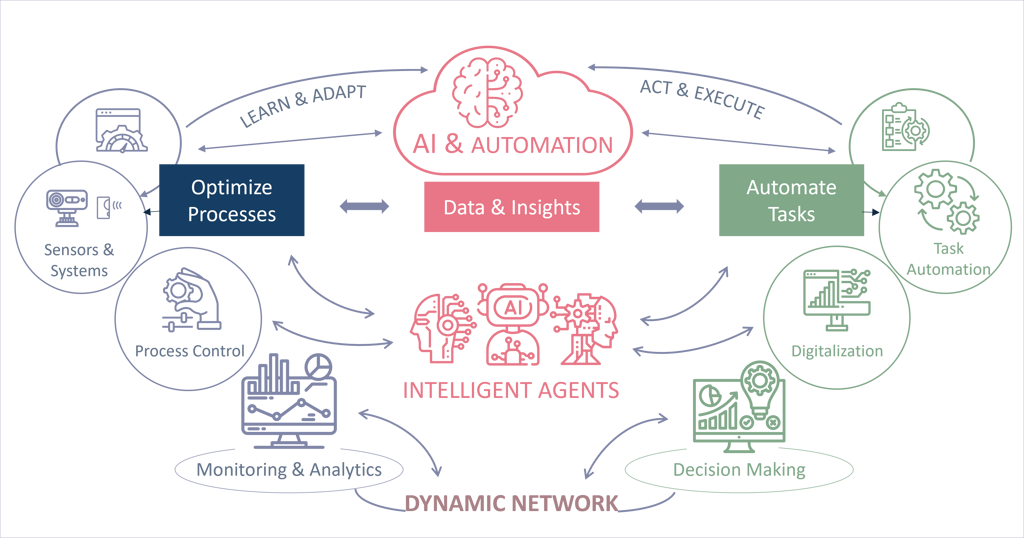
Human roles change too. Agentic AI does not replace expertise; it repositions it. Engineers become orchestrators, analysts curate the contextual data agents rely on, and leadership shifts toward designing and overseeing intent-driven systems — from task execution to architecture and strategic enablement. Workforce development must follow: staff need to understand agent behavior, interpret system feedback, and design governance that aligns with business goals, with real cross-functional work between IT, operations, and strategy.
Much of the technical foundation — models, APIs, compute — already exists. What is not yet routine is production closed-loop operation at scale; most operators run agentic capability in pilots, not lights-out. The harder requirement is the mindset shift: treating workflows not as static scripts but as dynamic interactions among agents, systems, and people. That shift means embracing experimentation and iterative design — prototyping agentic workflows, measuring outcomes, and refining orchestration logic continuously. Success depends as much on cultural readiness as on technology adoption.
Security is paramount. Autonomous agents must operate within defined trust boundaries, with identity verification, access controls, and behavioral monitoring; as workflows become more distributed and adaptive, the attack surface grows and needs threat detection and response built for agentic environments. Misuse is a distinct risk: without oversight, agentic AI could be repurposed for surveillance overreach, data manipulation, or automated denial-of-service, and rogue or compromised agents could abuse privileges to disrupt operations or exfiltrate data. Security here must cover internal misuse — misconfiguration, compromised credentials, adversarial manipulation of learning models — not just external threats.
Workflows must be managed not solely as task sequences, but as outcome-driven processes. In networks powered by agentic AI, operational success is measured not only by uptime but also by predictive capability, adaptability, and the integration of shared intelligence. Workflows are not just scripts anymore; they are more like conversations between agents, systems, and humans. It's a shift from managing tasks to managing outcomes. Because in a network powered by agentic AI, success isn't just about uptime — it's about foresight, agility, and shared intelligence. This redefinition of success encourages organizations to develop new KPIs — ones that reflect responsiveness, learning velocity, and collaborative intelligence. Agentic workflows are not just operational tools; they are strategic assets that shape the future of networked systems.