The Hidden Cost of Poor Governance in Tech Projects
A Telecom Network Perspective
4 Minute Read

In telecom networks, governance often takes a backseat to innovation, speed, and delivery. Beneath the surface of ambitious rollouts and modernization programs lies a quieter threat: poor governance. Its costs are rarely immediate, but they compound over time — eroding operational integrity, inflating budgets, and undermining stakeholder trust.
Governance in tech projects is the framework of processes, policies, and decision-making structures that keep a project aligned with organizational goals — delivering value, managing risk, and controlling resources. It defines roles, responsibilities, and accountability, establishing how decisions get made and how progress is monitored across the project lifecycle.
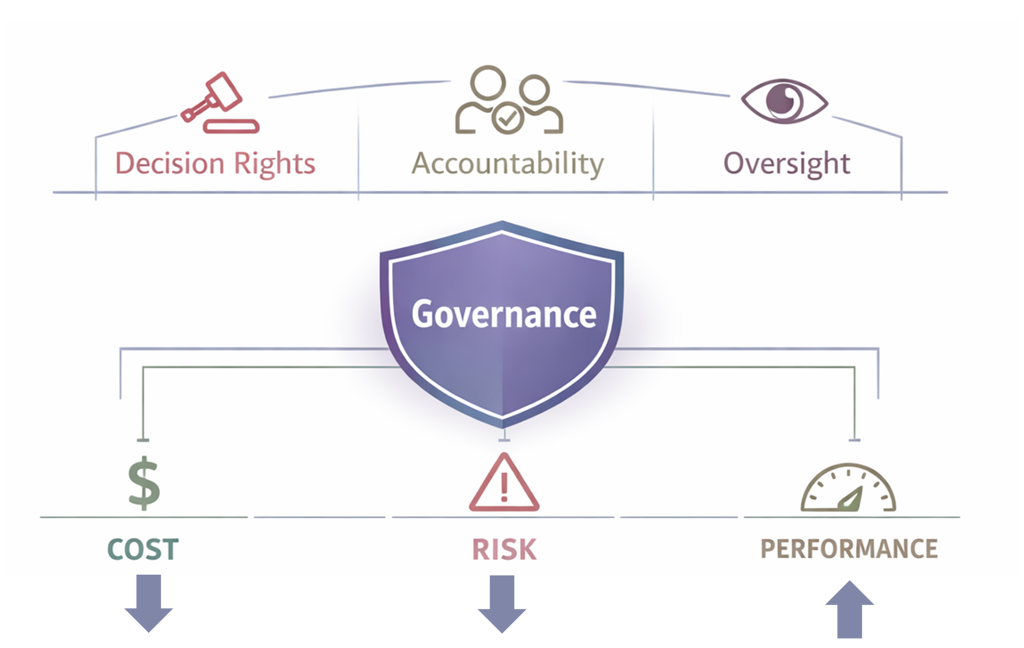
When applied to telecom projects, governance refers to the frameworks, decision rights, accountability structures, and oversight mechanisms that guide network design, deployment, and lifecycle management. It encompasses architecture compliance with standards and regulatory mandates, vendor and partner alignment across multi-domain ecosystems, change control and escalation protocols, security and credential delegation policies, and budgetary discipline with milestone tracking. When these elements are weak or inconsistently applied, the consequences ripple across the network stack, leading to inefficiencies, vulnerabilities, and operational drift. Poor governance often leads to siloed decision-making, resulting in fragmented network topologies. In the absence of a unified architectural blueprint, teams may deploy overlapping or incompatible technologies. This disjointed approach drives redundant infrastructure investments, increases latency due to inefficient routing, and raises maintenance overhead across both legacy and modern systems.
Procurement decisions made without strong governance tend to prioritize short-term convenience over long-term flexibility. This opens the door to vendor lock-in and contractual drift, where proprietary dependencies limit interoperability, upgrade costs escalate, and service-level agreements fail to reflect operational realities. The result is a network ecosystem that becomes increasingly rigid and expensive to evolve.
In multi-tenant environments, weak governance around access delegation introduces credential sprawl and security gaps. Admin privileges may go untracked across platforms, exposing the network to insider threats and credential misuse. These vulnerabilities also pose compliance risks under frameworks such as the NIST Cybersecurity Framework, ISO/IEC 27001, or jurisdiction-specific telecom mandates, potentially leading to legal and reputational consequences. Governance breakdowns often become most visible during outages, where delayed incident response can severely impact service continuity. Without clear escalation paths and accountability matrices, mean time to repair (MTTR) increases, root cause analysis becomes politicized or inconclusive, and customer trust erodes with each unresolved disruption. The absence of structured response protocols amplifies operational chaos.
Projects that lack governance discipline frequently suffer from budget overruns and scope creep. Uncontrolled change requests, misaligned stakeholder expectations, and reactive firefighting divert resources from strategic initiatives. Instead of driving innovation, teams become mired in tactical fixes, undermining long-term value and eroding confidence in the project's direction.
Consider a Tier-1 operator deploying a hybrid cloud orchestration layer. In the absence of governance guardrails, the orchestration logic may bypass existing assurance systems, API integrations with OSS/BSS platforms may remain undocumented, and performance metrics could be manipulated to meet superficial KPIs. These gaps create a brittle ecosystem where automation conceals underlying fragility rather than reinforcing operational resilience. Without structured oversight, the orchestration layer risks becoming a siloed mechanism that undermines the broader goals of network assurance and service continuity.
To mitigate these hidden costs, telecom leaders should adopt governance models tailored to the realities of network operations. This includes implementing role-based delegation for platform access and configuration, establishing architecture review boards with cross-functional representation, and enforcing vendor-neutral procurement frameworks. Integrated change management across NOC, SOC, and DevOps teams ensures alignment and accountability, while transparent budget tracking tied to service-level outcomes reinforces fiscal discipline. These practices help transform orchestration from a reactive tool into a strategic enabler of network integrity and agility.
Governance is not bureaucratic overhead — it is a strategic enabler. In telecom networks, where complexity is the norm and uptime is non-negotiable, weak governance is a silent liability. Operators that treat governance as a design input — not a compliance afterthought — can safeguard performance, control cost, and scale with confidence. The practical first step is concrete: name the decision rights and escalation paths for the next network program before the build begins, not after.