Intent-Based Networking: A Future of Autonomous Telecom Operations
A framework for translating business goals into automated network behavior
4 Minute Read

As telecom networks evolve toward greater complexity and scale, traditional configuration and management models are increasingly challenged. Manual provisioning, static policies, and reactive fault resolution are no longer sufficient to meet the demands of dynamic service environments. Intent-Based Networking (IBN) introduces a fundamentally different thought process, enabling operators to define desired outcomes rather than specific configurations, and allowing the network to autonomously translate, validate, and enforce those intents across infrastructure domains.
IBN is built on the principle of abstraction. Instead of issuing low-level commands, operators articulate high-level objectives — such as ensuring low latency for mission-critical applications or prioritizing bandwidth for enterprise clients. These intents are processed by the IBN system, which uses AI, policy engines, and telemetry data to generate and apply the necessary configurations. The system continuously monitors network state to ensure compliance with the original intent, adjusting parameters as conditions change.
IBN supports a wide range of operational goals. For example, an operator may define an intent to maintain sub-10ms latency for autonomous vehicle slices, or to isolate traffic for a specific service to meet regulatory requirements. The IBN system interprets these goals, configures routing paths, allocates resources, and applies traffic isolation parameters accordingly. If congestion or anomalies arise, the system can reconfigure the network in real time to preserve the intended service quality.
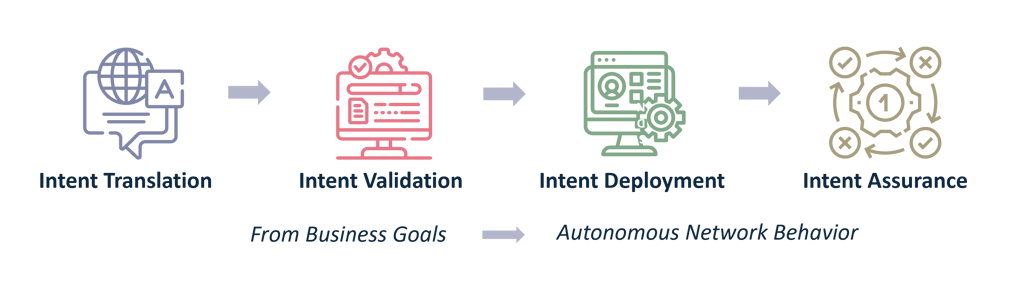
The IBN architecture typically has four functional layers, forming a closed loop: (1) Intent Translation converts human-readable goals (or northbound API calls per TMF921) into machine-executable policies. (2) Intent Validation simulates and verifies that the proposed configurations will achieve the desired outcomes before they touch production. (3) Intent Deployment applies configurations across network elements via SDN controllers, NFV-MANO, and RIC frameworks. (4) Intent Assurance continuously monitors KPIs and compliance, using closed-loop automation (ETSI ZSM closed-loop pattern; TM Forum AN L3 and above) to keep network behavior aligned with the original intent.
Telemetry data plays a critical role in intent assurance. Real-time metrics such as throughput, jitter, and packet loss are analyzed to detect deviations from expected behavior. If a slice supporting industrial automation begins to experience latency spikes, the IBN system can reroute traffic, adjust QoS parameters, or scale resources to restore compliance. These actions are taken autonomously, reducing the need for manual intervention and accelerating response times. Scenario modeling and predictive analytics further extend the capabilities of IBN. Operators can simulate the impact of new intents — such as adding a high-bandwidth slice for a live event — and assess implications for resource allocation, performance thresholds, and service continuity. Historical data informs these simulations, enabling proactive planning and risk mitigation.
Intent-Based Networking also strengthens orchestration across the transport layer by embedding service-specific intents into slice templates. These templates guide the dynamic configuration of IP/MPLS routing paths, bandwidth allocation over optical backhaul links, and latency enforcement between distributed and central units within the RAN. This level of control ensures that slices supporting applications such as industrial automation or real-time media maintain deterministic performance across physical and virtual transport domains. By aligning resource behavior with defined service parameters, IBN enhances consistency and responsiveness within the underlying network infrastructure.
By shifting from configuration-based management to outcome-driven orchestration, IBN represents a foundational step toward autonomous operations. It aligns network behavior with business strategy, reduces operational complexity, and enhances resilience. As networks become more disaggregated and service demands more diverse, IBN provides a scalable framework for intelligent automation.
Offering a structured, adaptive approach to network control, Intent-Based Networking positions operators to meet evolving service requirements with precision and agility. By embedding business logic into the orchestration layer and leveraging real-time analytics, networks can transition from reactive systems to proactive ecosystems, capable of self-optimization, self-healing, and continuous alignment with strategic goals.