Intent-Driven Operations: Natural Language Network Management
Why Talking to Your Network Is the Next Big Shift
5 Minute Read

For two decades, RAN operations have run on the same primitives: CLI commands against the EMS, parameter files exported from the NMS, runbooks in Confluence, and SON functions that tune a fixed set of features (MLB, MRO, ANR, energy savings). Each action required an engineer to translate a business goal — "hold the SLA for the enterprise slice in Sector 3" — into a sequence of vendor-specific parameter changes across hundreds of cells. That translation layer is what intent-driven operations propose to remove.
5G Advanced and 6G are no longer systems you configure. They're ecosystems you orchestrate — dynamic, multi-layer, multi-vendor, AI-native environments where intent matters more than syntax.
That's where intent-driven operations enter the story. From Commands to Conversations. The idea is simple: operators express what they want in natural language. The network figures out how to make it happen. Instead of:
- modify cell-123 tilt -2
- update CA policy for slice-7
- adjust MCS thresholds for mobility cluster B You say:
- "Improve cell-edge throughput for the stadium cluster."
- "Reduce energy consumption in low-traffic zones after midnight."
- "Guarantee 50 Mbps for the enterprise slice in Sector 3."
The system interprets the intent, plans the steps, executes them, and verifies the outcome. This is not science fiction — it's the logical evolution of automation in an era where complexity has outpaced human bandwidth. 5G-Advanced (3GPP Release 18 and 19) and the path to 6G assume a different operating model: multi-vendor RAN with O-RAN-defined interfaces, network slicing governed by NSSF/NSSAAF, and analytics surfaced through NWDAF. The TM Forum's intent management work (TMF921, IG1253, TR-178 / IG1230) defines a formal model for closing that gap. Natural language isn't just a convenience feature; it addresses some of the deepest structural challenges in telecom operations. As networks grow more complex — with Massive MIMO, carrier aggregation and dual connectivity, network slicing, RIC-driven control loops, and multi-vendor orchestration — manual workflows simply can't keep pace. Expertise is uneven across teams, with senior engineers understanding the strategic "why" while junior engineers focus on the procedural "how," and intent-based interaction helps bridge that divide. Real-time RAN decisions also demand a level of speed that human interpretation can't consistently deliver. At the same time, business goals such as improving VIP experience or reducing churn rarely map cleanly to technical parameters. Natural language becomes the connective tissue between business objectives and technical execution, allowing operators to express what they want the network to achieve while the system determines how to make it happen.
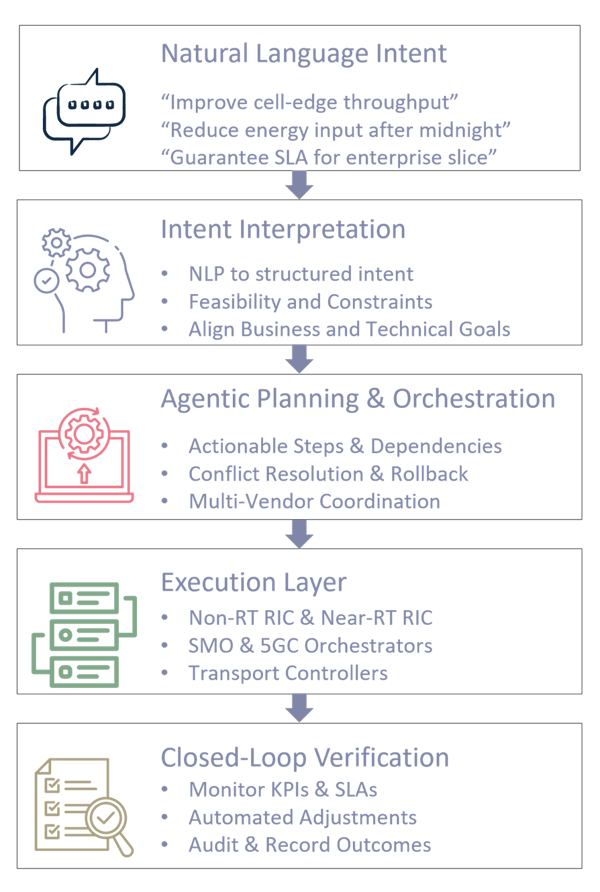
Intent-driven operations decompose into three layers, each with a different maturity profile. Intent interpretation translates the natural-language request into a structured intent (typically TMF921 / IG1253 aligned). Agentic planning and orchestration decomposes the intent into actions with dependencies, conflict checks, and rollback paths — and this is the layer with the least operator-grade precedent. Execution dispatches actions to controllers that already run the network: Non-RT RIC rApps over O-RAN R1, Near-RT RIC xApps over E2, SMO workflows, 5GC orchestrators, and transport controllers.
Real-world intent examples show how agentic systems translate high-level goals into coordinated network actions. When an operator says, "Optimize mobility for the morning commute," agents automatically adjust handover thresholds, beam patterns, load-balancing behavior, and CA/DC policies to deliver smoother mobility, fewer drops, and better throughput. A request like "Cut energy usage by 20% in rural clusters" triggers actions such as deactivating carriers, reducing MIMO layers, and tuning power allocation so the network saves energy without degrading user experience. And when the goal is to "Guarantee SLA for the enterprise slice," agents coordinate PRB allocation, scheduling weights, QoS flows, and transport-layer congestion predictions to ensure deterministic, contract-level performance.
Telecom has reached a stage where traditional approaches can no longer keep up: automation alone is insufficient, rule-based systems break under edge-case pressure, and human-driven workflows simply can't scale with the complexity of modern networks. Intent-driven operations change the equation by enabling faster decision cycles, reducing operational overhead, increasing engineer productivity, improving predictability, and aligning network behavior more closely with business objectives. It marks a shift from configuring a network parameter by parameter to commanding the network with clear, outcome-focused intent.
Intent-driven operations do not eliminate the OSS, the EMS, or the engineer. They change where the engineer spends time: less typing of parameter changes, more reviewing of proposed plans, conflict resolution between competing intents, and auditing of closed-loop outcomes. The win is not "the network thinks for itself"; the win is shorter cycle time on the work the operator already does, with a structured intent record that survives the engineer who created it.
Closing Thought: SON automated a fixed set of self-optimization tasks. AI/ML added pattern recognition and prediction. Intent-driven operations, if they land, add a structured way to express what the network is supposed to do. The control plane has not moved to natural language. The interface has — and that, on its own, is enough to be worth the work.