Maximizing Network Operations Ticketing
From reactive triage to proactive assurance: unlocking the full value of ticket data
6 Minute Read

Most operators still treat the trouble ticket as a record-keeping artifact: a row in a queue, a timestamp on an SLA report, a line item in the post-incident review. That underuses the asset. A ticket touched by fault management, performance monitoring, inventory, the field workforce, and the customer-facing portal is the densest cross-domain dataset in an OSS — and the only place where the cost of an outage is reconciled against the operational work it generated. The question is not whether ticketing matters; it is whether the operator is extracting strategic intelligence from it or merely closing it.
Maximizing the value of ticketing systems requires a shift from basic fault logging to intelligent orchestration. It is about elevating ticketing from a reactive support function to a strategic enabler of operational excellence. Traditionally, ticketing systems have served as repositories for fault reports, service requests, and maintenance logs. They help track incidents, assign tasks, and document resolution timelines. But in today's telecom landscape, where uptime is paramount and SLA violations carry financial penalties, ticketing has to do more than record — it has to inform, prioritize, and accelerate.
Instrumented ticketing converts raw alarms into a closed-loop workflow — fault detection through analytics feedback — anchored to TM Forum Open APIs and ITIL v4 problem management. The analytics feedback loop returns lessons to fault detection thresholds and prioritization models. Effective ticketing systems act as operational nerve centers. They integrate with fault management platforms, performance monitoring tools, and orchestration layers to provide a unified view of network health. When enriched with contextual data, tickets become actionable insights rather than static records.
Five capabilities separate a record-keeping ticketing stack from an instrumented one. Contextual enrichment. Raw alarm data — a port down, a card failure, a KPI threshold crossing — is insufficient for triage. Enriched tickets append topology context from the inventory system, service impact from the service inventory (which customers, which SLAs, which revenue), and historical resolution patterns from the ticket archive. Operators using NetCracker or Cramer as the system of record for inventory typically expose this through a federation layer rather than direct database calls. Automated prioritization. AI-driven scoring evaluates urgency against customer impact, SLA risk, and network criticality. The realistic baseline today is supervised classification trained on historical ticket-to-SLA-outcome pairs, not generative AI. The honest measure of value is the reduction in manual triage time and the lift in correct severity assignment on the first touch — both auditable against the prior six months of ticket data. VERIFY: claims that AI prioritization reduces manual triage by a specific percentage should be tied to a named operator deployment or vendor case study; generic vendor benchmarks are not transferable.
Workflow integration. Closed-loop resolution requires the ticket to talk to provisioning (often via TMF641 Service Ordering), assurance, and — where customer impact is involved — BSS billing and CRM. Operators commonly run ServiceNow ITOM or BMC Helix as the workflow engine, with TMF Open APIs as the integration layer. The failure mode is well-known: bolt-on integrations that work in lab but break on multi-vendor handoffs in production.
Field force coordination. Geo-tagged tickets, mobile dispatch, and real-time updates feed Salesforce Field Service, ServiceNow FSM, or IFS Field Service Management. The MTTR improvement comes from compressed dispatch latency and reduced repeat truck rolls, not from the ticket itself. VERIFY: published MTTR improvements from field-force integration vary widely (10–40% reductions cited by vendors); the operator's baseline matters more than the vendor benchmark.
Analytics feedback loops. Trend analysis surfaces recurring faults, process bottlenecks, and training gaps — the inputs to ITIL v4 Problem Management. This is where ticketing earns its keep beyond incident closure: feeding preventive maintenance schedules, capital planning, and vendor performance reviews.
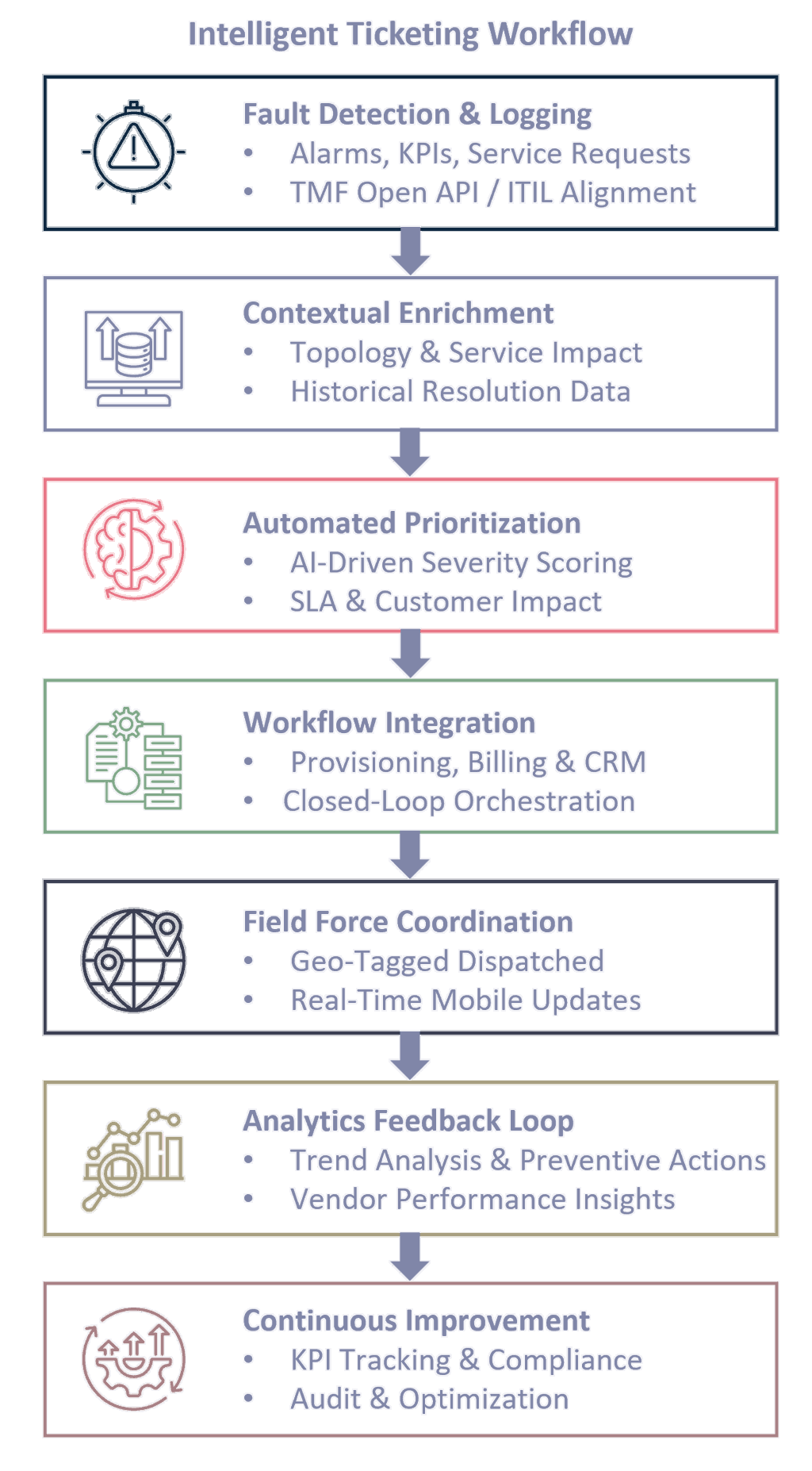
To maximize ticketing effectiveness, it is imperative that system capabilities align with business outcomes through well-defined operational considerations. This includes defining resolution KPIs such as Mean Time to Repair (MTTR), first-time fix rate, and escalation frequency to measure operational performance. Establishing standardized ticket taxonomies enhances reporting accuracy and enables automation across support workflows. Ensuring data integrity is critical, as incomplete or inconsistent tickets can compromise analytics and decision-making. Role-based access helps, so engineers, managers, and field staff each receive tailored views suited to their responsibilities. Finally, enabling audit readiness through comprehensive ticket logs ensures regulatory compliance and supports SLA verification.
The evolution mirrors the broader shift in telecom operations — from reactive fault management to proactive service assurance, and in TM Forum terms, from AN Level 1 toward AN Level 3 closed-loop automation. Integrated with streaming telemetry, AIOps, and orchestration, the ticket becomes the audit trail of an automated decision rather than the trigger for a manual one.
A concrete scenario: a fault in a virtualized RAN cluster — say, a CU-UP container failure — surfaces in the fault manager, gets correlated with sector-level KPI degradation, and is opened as a ticket pre-populated with the affected cell IDs, the wholesale and retail customers served, the recommended remediation runbook, and a dispatch order if truck-roll is required. The customer portal updates. The incident logs hit the audit store. The NOC engineer reviews and approves rather than originates.
Maximizing ticketing ROI requires continuous benchmarking across key operational metrics. Telecom operators should consistently track reductions in Mean Time to Repair (MTTR), the ratio of auto-generated to manual tickets, escalation rates, and resolution velocity. Monitoring field technician dispatch efficiency and improvements in SLA adherence linked to ticketing enhancements is equally important. Together, these metrics provide a quantifiable view of ticketing performance, helping justify future system upgrades and guiding strategic investment decisions.
In a telecom network where service continuity is non-negotiable, ticketing systems evolve beyond fault logging. By embedding intelligence, automation, and integration into ticketing workflows, incident management can be transformed into a strategic asset. The result is faster resolution, better compliance, and a more agile operations environment — one ticket at a time. Ticket data needs to be treated as the system of record for operational decisions — not as the paper trail after the fact.