Measuring ROI on Mobile Network Investment
Why ARPU and Subscriber Growth Are Not Enough
5 Minute Read

Quick Summary: “ROI on mobile-network investment cannot be read off ARPU and subscriber growth alone; it needs a multidimensional frame that weighs four kinds of value against total cost of ownership. Financial and operational KPIs together- ARPU, CLTV, CAC, capex intensity, churn, throughput, latency, uptime, are what make the return legible to shareholders, regulators, and enterprise buyers.”
Mobile network operators (MNOs) spend billions a year to extend coverage, lift performance, and stand up next-generation services: 5G, fixed wireless access (FWA), IoT. The return on that spend is under harder scrutiny than ever, and not only from shareholders: regulators, wholesale partners, and enterprise customers all want to see it. The problem is that the return does not show up cleanly in the two metrics operators reach for first, subscriber growth and ARPU. A defensible ROI needs a multidimensional frame that captures direct financial gains and indirect benefits, measured against total cost of ownership (TCO).
The capital at stake is enormous. GSMA figures put MNOs at the center of global mobile-infrastructure investment, on the order of $150B+ per year by its accounting, spanning RAN expansion for urban densification and rural coverage, core upgrades to virtualized and cloud-native functions, transport (fiber, IP/MPLS), spectrum acquisition and licensing, and operational platforms (OSS/BSS, analytics, AI). Yet operators routinely capture less direct value from that infrastructure than the over-the-top, cloud, and content players riding on top of it, the unresolved fair-share and value-capture debate that sits underneath every ROI conversation.
ROI is, in principle, net return over total investment cost times 100. For mobile networks it is rarely that clean, and rarely purely a dollar figure. Both sides of the ratio have to be defined deliberately: gains span operational efficiency, enhanced capability, and new revenue; costs span development, infrastructure, maintenance, and security. Getting the definitions right is most of the work.
On the gains side: operational efficiency is the cost taken out by automation, real-time operations, and productivity; enhanced capability is the growth from new services (high-quality video, AR/VR, IoT); new revenue is private 5G, edge, and similar offerings; and non-financial benefits (customer satisfaction, security, compliance) sit outside the formula but drive financial gain and cost avoidance indirectly. On the cost side, count the full TCO: up-front hardware, software, and deployment; ongoing maintenance and upgrades; the OPEX of running the network; and the training that lets staff actually operate the new technology.
No single KPI carries ROI; a blend of financial and operational indicators does. Financial: ARPU (revenue per customer), Customer Lifetime Value (long-run contribution), Customer Acquisition Cost (efficiency of winning subscribers), and capital efficiency, best read as capex intensity, i.e., capex as a share of revenue. Operational: churn, throughput, latency, and availability/uptime, each of which feeds customer satisfaction and, through it, the financials. Layer in productivity and security metrics (incident and compliance-breach reductions), and ROI becomes a measure of operational resilience and customer trust, not just margin.
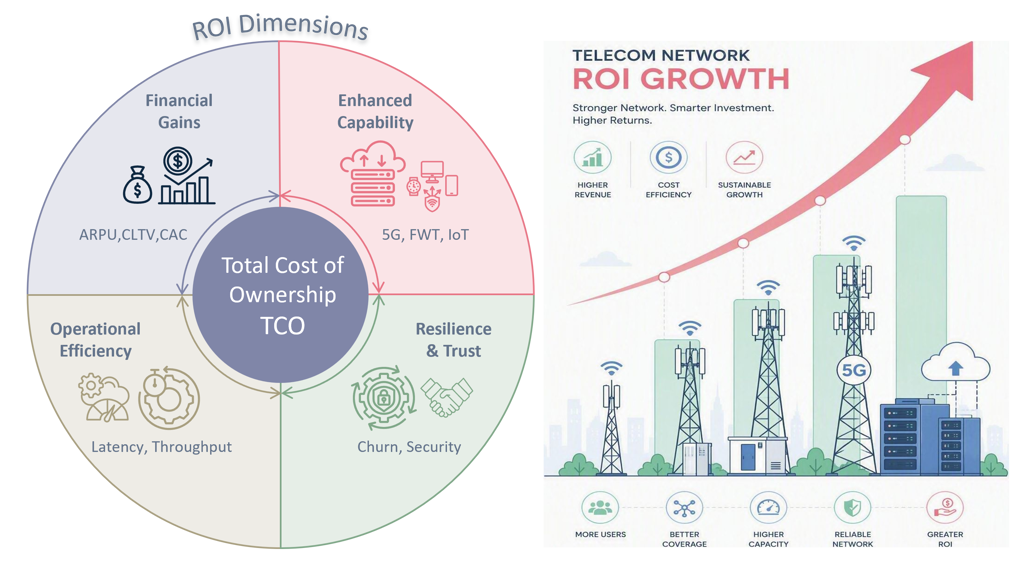
AI-powered monitoring and predictive analytics increasingly tighten the link between spend and measurable outcome, forecasting demand hotspots, optimizing resource allocation, and modeling ROI scenarios across geographies and service tiers. Correlating investment with performance moves operators from reactive cost tracking toward deliberate value realization, so capital commitments can be tied to specific efficiency and service-quality gains rather than asserted after the fact. Several levers move ROI in practice, and they tier by certainty. Highest-confidence: automate manual network operations and remediation to cut cost and cycle time. Next: favor technologies that are quick to deploy, configure, and maintain, which lowers implementation and support overhead. Underpinning both: invest in training and hold vendors to their support commitments, since adoption, not procurement, is where value is won or lost. And do not overlook the commercial hygiene: disciplined audits of vendor and supplier contracts surface savings and negotiating leverage.
Measuring ROI honestly means naming the hard parts. Multi-technology estates spanning 2G through 5G make it difficult to isolate the impact of any one investment. Indirect benefits, satisfaction and innovation headroom, resist clean dollar quantification. And operators are increasingly expected to translate technical capability into business value, ensuring that spend on features like URLLC (low latency) or network slicing is tied to genuinely high-value use cases rather than capability for its own sake.
As the industry moves toward 6G and AI-native operations, ROI measurement should shift from static financial snapshots to dynamic, intent-aware models that update as the network and the demand do. The operator’s job is threefold: align investment with monetization, advocate for policy that balances infrastructure cost against the ecosystem value others capture, and make the broader economic contribution of the network legible to stakeholders. Framed that way, ROI stops being a backward-looking accounting number and becomes a forward-looking measure of resilience, innovation, and trust, which is exactly the case operators need to make to the regulators and enterprises now asking for it.