

Quick Summary: “5G slicing turns one network into many SLAs to prove, and legacy oversight cannot watch them all. Effective slice monitoring spans the service, network-function, and infrastructure layers, correlated in one observability framework with NWDAF analytics and ETSI ZSM closed-loop remediation. Start by instrumenting one or two high-value slices end to end.”
5G network slicing lets operators carve one physical network into many virtual slices (3GPP S-NSSAI), each tuned for a different service — performance, latency, security. That flexibility is also the problem: every slice is a separate SLA to prove, and legacy network oversight was never built to watch dozens of them at once. Slicing needs monitoring designed for slices.
Where legacy networks had largely uniform metrics, 5G slices are service-specific. A remote-surgery slice needs ultra-low latency and high reliability (URLLC); an IoT-sensor slice prioritizes energy efficiency and device density (mMTC); an AR/VR slice needs high throughput (eMBB) and continuous recalibration as user movement and content change. Monitoring must therefore be slice-aware — tracking KPIs that reflect each slice's intent and SLA (3GPP TS 28.554 defines 5G end-to-end KPIs) — and shift from static thresholds to dynamic, context-aware evaluation.
Without robust monitoring, operators carry real risk: SLA violations that surface only when customers feel them, resource contention between slices, limited ability to troubleshoot or optimize, and compliance gaps in mission-critical services. Multi-tenant infrastructure amplifies all of it — one tenant's misbehaving slice can degrade the others, eroding trust and complicating SLA enforcement. Slice isolation (the noisy-neighbor problem) is as much a monitoring requirement as a security one. Effective slice monitoring spans three layers, each a different vantage point. The service layer watches end-to-end, user-perspective metrics per slice — latency, jitter, throughput. The network-function layer observes the virtualized and containerized functions (VNFs and CNFs) inside each slice. The infrastructure layer tracks the compute, storage, and transport allocated to slices and the isolation between them. These feed one observability framework that correlates metrics across domains and across the slice-management functions (NSMF/NSSMF), so operators can hold SLAs and respond to deviations — and trace an anomaly from user experience down to an infrastructure bottleneck, cutting mean time to repair (MTTR).
Modern slice monitoring blends a few technologies. Streaming telemetry collects data continuously from distributed components so anomalies surface before they hit service. AI/ML adds prediction — forecasting slice degradation and flagging corrective actions from historical patterns, and spotting usage trends so capacity can be provisioned ahead of demand spikes such as major events or seasonal surges. In the 5G core, the standardized home for this analytics is the NWDAF (3GPP TS 23.288, Release 15 onward).
Intent-based monitoring keeps what is measured aligned with what was promised, so KPIs reflect the service intent rather than convenient proxies (TM Forum's intent work, TMF921). Closed-loop automation goes further, wiring monitoring into orchestration so a breach triggers automated remediation or scaling — the loop ETSI ZSM standardizes. To work, these tools must be cloud-native, scalable, and interoperable across multi-vendor estates. That matters most in O-RAN and disaggregated architectures, where components from different vendors must interwork and slice assurance can ride the SMO / Non-RT RIC; tools must normalize data across platforms and expose APIs into orchestration and assurance.
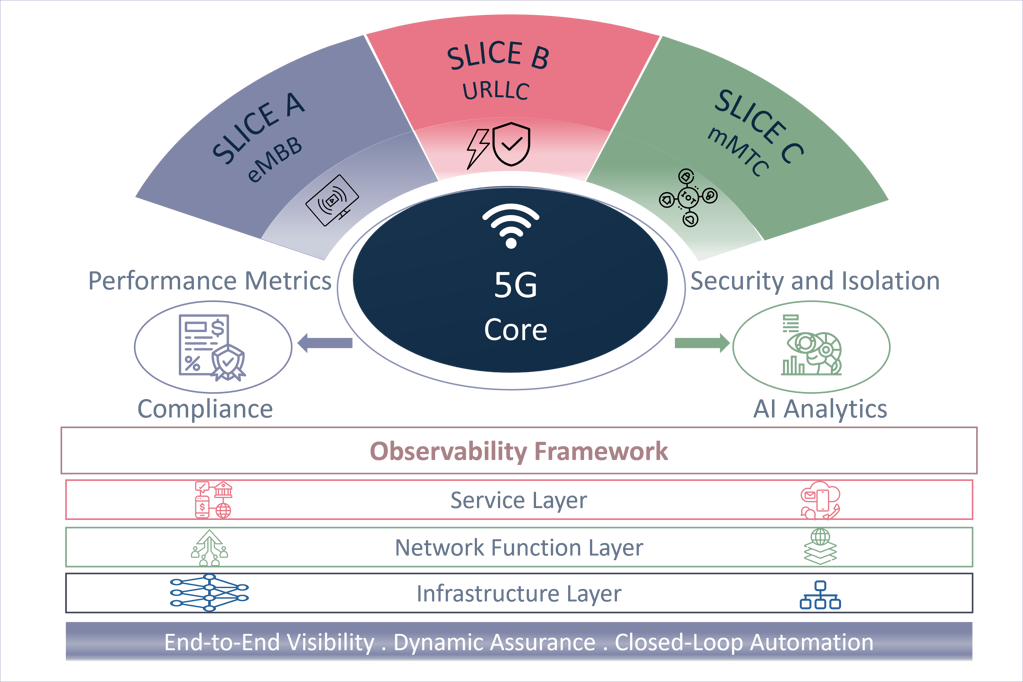
The operational challenges are real. Monitoring hundreds of slices in real time generates massive telemetry volumes that demand scalable, fine-grained systems. Slice-specific KPIs and interfaces are still standardizing, which hampers interoperability and consistent tracking. And legacy OSS/BSS often cannot ingest or act on slice-level insight, creating integration bottlenecks that slow response. To cope, operators are adopting observability-as-a-service — monitoring delivered via cloud platforms with built-in scale, analytics, and compliance.
Security and privacy stay front-of-mind. U.S. government guidance — the CISA/NSA/ODNI Security Considerations for 5G Network Slicing — flags unauthorized access and cross-slice interference on shared infrastructure: a breach in one slice can reach others, causing data leakage or disruption. Mitigations include strong encryption and authentication, and slice isolation enforced through the NFV/SDN layer (which are isolation enablers, not security controls on their own). Continuous monitoring with ML-based anomaly detection is essential for proactive threat detection, and tools should support forensic reconstruction of the events before a breach. As adversaries grow more capable, slice-level security observability becomes part of maintaining trust in 5G.
As slicing goes mainstream, monitoring shifts from reactive troubleshooting to proactive assurance. Near-future frameworks are likely to embed digital twins that simulate slice behavior under stress and expose real-time SLA dashboards to enterprise customers — dashboards that show not just current performance but predictive alerts before an SLA breaches. That confidence is what lets providers sell performance guarantees, opening new monetization models.
Slice observability is not just a technical necessity anymore — it's a strategic differentiator. Operators who master slice observability will be better positioned to deliver differentiated services, uphold SLAs, and monetize 5G with confidence. In a competitive landscape where customer expectations are rising, the ability to assure performance at the slice level will define market leaders. Monitoring is no longer a back-office function — it's a frontline capability that shapes customer experience, operational agility, and long-term profitability.