Network Reporting ROI: Measuring Value Beyond Visibility
Turning network data into operational savings, uptime, and strategic advantage
6 Minute Read

In a telecom network where downtime carries SLA penalties and churn, network reporting is no longer a passive function — it is a strategic asset. As operators face mounting pressure to optimize performance, cut costs, and accelerate decisions, the return on investment (ROI) of reporting systems deserves the same scrutiny as any capital line item. The case has to go beyond "better visibility": effective reporting frameworks drive operational efficiency, regulatory and SLA compliance, and measurable customer-experience gains.
The ROI of network reporting resolved into multiple levers, each pairing the mechanism that creates value with the operator KPI that proves it.
Network reporting ROI is the measurable value generated by investments in data collection, analytics, and visualization across the network stack — fault, performance, configuration, and usage reporting, spanning physical and virtualized domains. The value is not purely financial: it includes engineer-time saved, SLA adherence, automation enablement, and the planning insight that comes from trending the data over time. TM Forum's Open APIs and business-value frameworks give operators a vocabulary for quantifying and benchmarking that value rather than asserting it.
The operator pain is concrete. Without continuous monitoring, fault isolation is manual and slow, asset visibility is partial, and every minute of undetected degradation is service impact the NOC cannot see. A reporting platform that ingests live telemetry, watches elements continuously, and raises an alarm the moment a KPI crosses threshold is what turns that blind spot into a tracked, time-stamped event. The relevant comparison is not "software cost versus no cost" — it is the platform's cost against the SLA penalties, downtime, and truck rolls that accrue without it.
Locating a fault is slow when inventory and topology records are stale or incomplete, and in a geographically distributed network a fix can wait on a technician's drive to a remote site. The time to find and repair a fault, plus the fuel and labor to reach it, are directly quantifiable costs — and they map to two KPIs operators already track: mean time to repair (MTTR) and truck rolls per fault. Reporting that delivers live diagnostics and geographic device location compresses MTTR and avoids dispatches that remote diagnosis can close, which is where the travel-budget savings actually come from.
Calculating ROI starts with naming the problems the investment will solve. The returns usually land in more than one place at once: a NOC that expected only faster fault resolution may also find it deferred a planned hire and lifted availability — the kind of second-order benefit that should be modeled deliberately, not treated as a happy accident. List the levers up front so each one can be measured against a baseline.
Effective reporting delivers ROI across several distinct dimensions. It raises operational efficiency by automating fault isolation, trend analysis, and capacity planning, letting teams move from reactive troubleshooting to proactive optimization. It supports regulatory and SLA compliance through accurate data exports, audit trails, and transparent stakeholder reporting. It improves customer experience with granular insight into service performance, latency, and packet-drop rates — enabling targeted intervention on the KPIs that drive QoE. And it drives resource optimization by surfacing underutilized assets, congestion hotspots, and energy inefficiency, which sharpens capacity-planning and infrastructure-investment decisions.
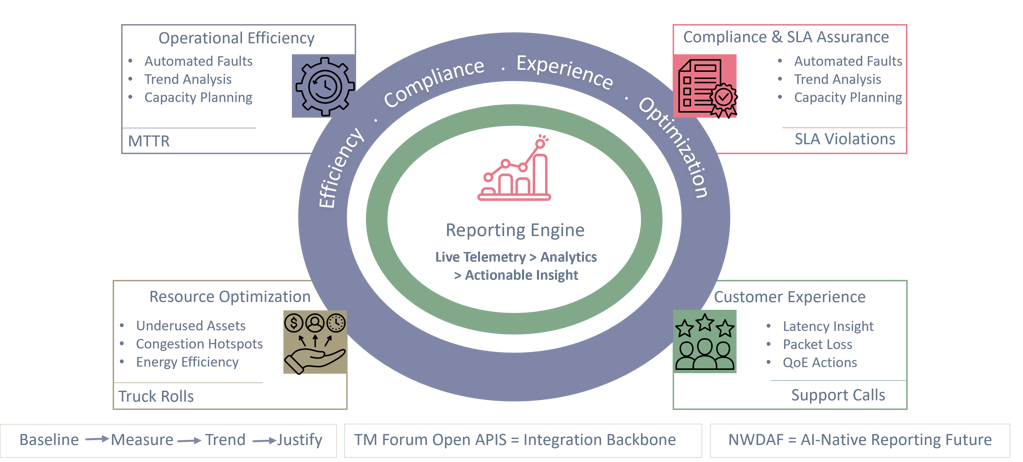
Several design trade-offs decide how much of that ROI an operator actually captures. Higher-resolution telemetry sharpens insight but raises storage and processing cost, so data granularity has to be aligned to operational need rather than collected by default. Integration matters as much as collection: reporting fragmented across orchestration (OSS) and billing (BSS) — rather than unified across service assurance — hinders usability and delays action, which is why TM Forum's Open APIs exist to stitch those domains together. Finally, static reports age quickly; dynamic queries, role-based views, and adaptable architectures are what preserve the platform's value as the network changes.
Reporting returns usually come from a combination of areas. Running a network takes trained technicians to maintain and upgrade equipment, provision users, handle support calls, and plan expansions. Tooling that lets a team hold or reduce headcount as the network grows returns value quickly and defensibly — and, as important, frees senior engineers from manual triage to work on the automation and capacity projects that move the business forward.
Network reporting can deliver ROI across at least the following levers, each tied to a metric an operator can baseline and trend: salary and staff-time savings; outage and downtime avoidance; reduced support calls; reduction in mean time to repair (MTTR); share of reports generated automatically; SLA violation rate before and after a reporting upgrade; time saved in regulatory audits; and cost avoidance from early fault detection. Benchmarking these over time is what converts a one-time business case into a standing justification for the next round of investment.
Once the savings are estimated, weigh them against the full cost of ownership — not just the purchase. That means licensing, product upgrades, maintenance contracts, any dedicated hardware, implementation consulting, training (including travel and onboarding), and ongoing administration such as staff or new hires. Modeling the fully loaded cost across a multi-year horizon, including operational overhead, is what produces a defensible payback period rather than a first-year sticker price — and it is the number that determines whether the investment clears the operator's hurdle rate.
Network reporting is more than a compliance checkbox; it is a strategic enabler of intelligent operations. Aligned to business outcomes, it yields tangible ROI across performance, compliance, and customer-satisfaction domains. As networks move toward AI-native operation — where standardized network analytics such as 3GPP's NWDAF (TS 23.288) feed automated decisions — reporting shifts from retrospective analysis toward real-time orchestration input, raising the stakes on the data quality underneath it. The discipline to instrument first is simple: pick the three or four levers above that matter most to your network, baseline them, and report the delta every quarter.