Network Slicing Under Load
How AI Turns SLA Targets into Real-Time Resource Allocation on 5G SA
6 Minute Read

TL;DR: Rule-based slice allocation cannot hold per-slice SLAs when traffic is volatile; AI adds forecasting and reinforcement-learning policy to reassign RAN, transport, and core in a closed loop. The payoff is SLA compliance and efficiency, but the orchestration plumbing, standards anchors (TS 23.501/28.530, NWDAF, O-RAN RIC), and slice isolation matter more than the model.
As 5G networks carry ultra-reliable low-latency communications (URLLC), massive machine-type communications (mMTC), and enhanced mobile broadband (eMBB) over shared infrastructure, operators face one hard question: how do you hold each service SLA when all of them draw on the same RAN, transport, and core? Network slicing, the 3GPP construct (TS 23.501) that partitions one physical network into isolated logical networks, is the structural answer, but slicing exists only on a 5G standalone (SA) core, and its value depends entirely on how the slices are orchestrated. This is where AI earns its place: not as a buzzword, but as the control logic that keeps each network slice instance (NSI) inside its performance envelope without starving the others. Slicing lets operators tailor logical networks to specific use cases -- automotive V2X, remote surgery, industrial IoT, each carrying its own S-NSSAI (Single Network Slice Selection Assistance Information) and SLA. The hard part is not creating the slice; it is keeping it compliant under real traffic.
Each slice carries distinct latency, throughput, and reliability targets, and traditional rule-based allocation cannot adapt fast enough when traffic and SLAs shift underneath it. AI-driven resource management adds predictive analytics, reinforcement learning, and real-time decisioning to retune slice configurations on the fly. In practice this logic runs in standardized places: as rApps on the O-RAN Non-RT RIC for RAN policy, and through the 3GPP management plane (NSMF/NSSMF, TS 28.530/28.531) for end-to-end slices, fed by NWDAF analytics (TS 23.288). The models analyze historical usage, forecast demand spikes, and reassign spectrum, compute, and transport ahead of congestion. The same machinery supports energy savings, throttling capacity in low-demand periods through carrier or cell sleep, though operators should treat carbon-reduction figures as a measured outcome rather than a default.
AI models ingest telemetry from the RAN, core, and edge to assess slice health, watching throughput, latency, jitter, and packet loss continuously. A V2X slice, for example, may need single-digit-millisecond air-interface latency (the URLLC budget in 3GPP TS 22.261) and high reliability, but end-to-end latency still depends on transport and core, so the air-interface figure is not the whole story. When congestion appears, the controller can prioritize that slice by reallocating bandwidth or steering traffic over less-loaded transport paths; during a large event it can lift capacity for the eMBB slices carrying video. These actions run with minimal human intervention, and in a disaster-recovery scenario the same control loop can re-weight slices toward emergency communications when infrastructure is degraded.
Modern orchestration ties this AI to NFV and SDN to close the loop, the pattern ETSI ZSM standardizes for zero-touch operations. Reinforcement-learning agents search allocation strategies offline, learning which actions hold SLAs under different conditions before those policies are validated and promoted to production; a well-trained agent might cut compute for a low-priority slice at peak without breaching its SLA. Dashboards expose slice health, utilization, and predictive alerts so operators keep oversight of an automated system rather than just watching it. These platforms also support intent-based operation, operators state the outcome (a latency ceiling, a cost target) and the system derives the configuration, using the TM Forum Intent Management API (TMF921) and 3GPP intent-driven management (TS 28.312).
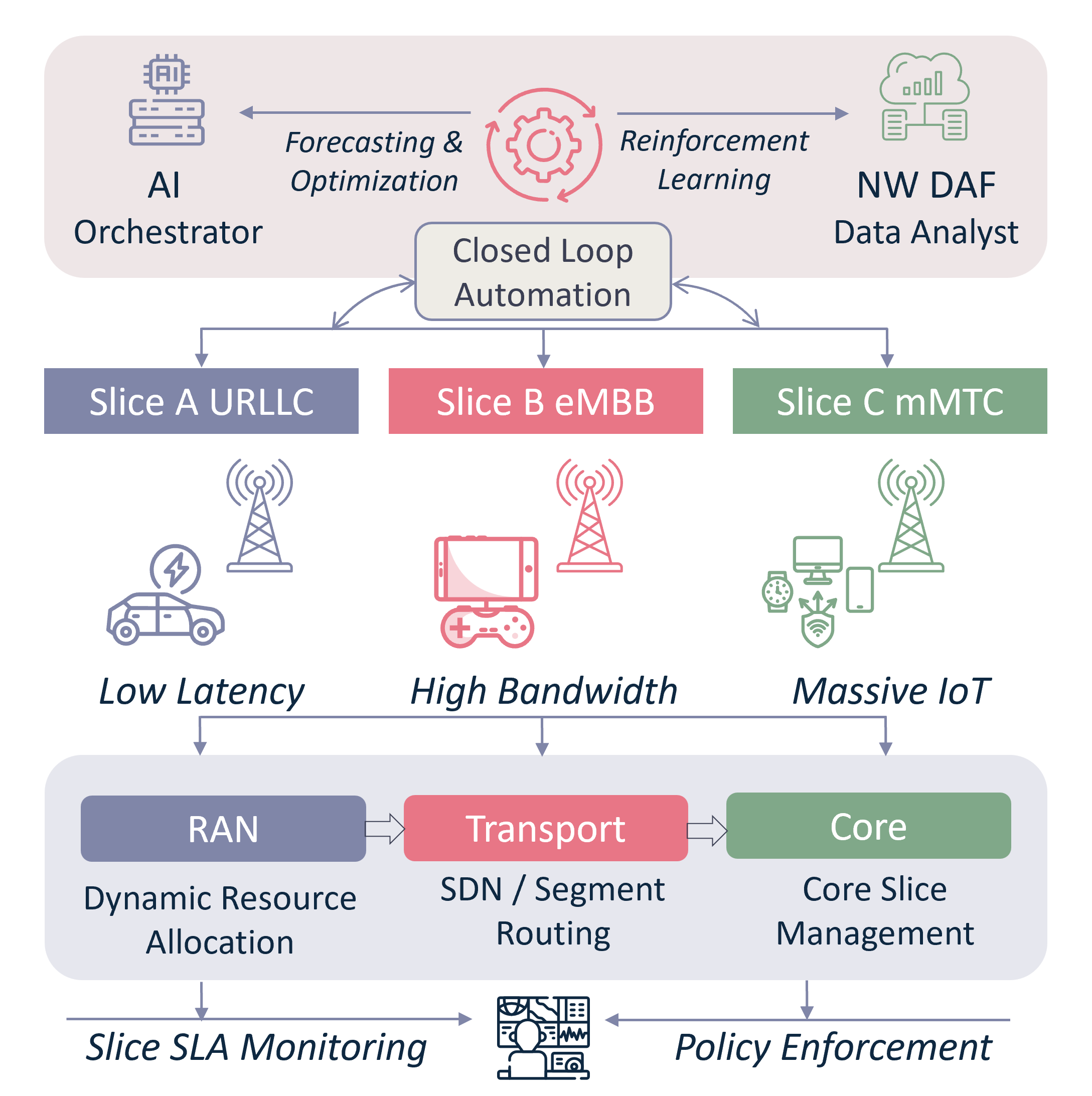
AI also arbitrates cross-slice contention. When slices share infrastructure, priorities collide, and the controller resolves conflicts by weighing slice priority and usage trends while honoring the isolation each S-NSSAI is contracted to provide. Usage patterns are learnable: an industrial-IoT slice that surges on factory-shift boundaries can be pre-provisioned rather than scaled reactively. Scenario modeling lets operators simulate adding or resizing slices and estimate the cost, latency, and throughput impact before committing, useful for seasonal peaks, special events, and drills. Most of this contention-resolution logic is still pilot-stage at NA operators; the modeling and forecasting pieces are further along than fully autonomous arbitration.
Layered on top, AIOps-style monitoring detects anomalies, localizes root cause, and can trigger corrective action. The models learn a normal-behavior baseline and flag deviations that signal faults or security events, including early hardware degradation and misconfiguration, feeding predictive maintenance. In a multi-tenant slice environment, that isolation is not optional: anomaly detection has to guarantee one slice fault or noisy-neighbor behavior does not cascade into another, which is an SLA and a security requirement, not just an efficiency one.
The business case is real. Flat-to-declining ARPU and sharper competition push operators toward better utilization and new revenue, and slicing lets them sell differentiated, SLA-backed offerings rather than undifferentiated capacity. Embedding AI in the orchestration is what makes those offerings operable at scale, keeping slices agile, compliant, and cost-effective while reducing manual overhead. The monetization paths are concrete: premium enterprise slices, performance-based dynamic pricing, and vertical bundles in healthcare, manufacturing, and smart cities, each of which only holds up commercially if the SLA behind it is enforceable.
As 5G evolves toward 6G, AI and slicing converge further, toward holographic media, real-time digital twins, and eventually agentic frameworks where autonomous agents manage slice lifecycles, negotiate resource contracts, and coordinate across domains by translating business intent into technical execution. That last step is aspirational today, not deployed, and should be read as a direction rather than a shipping capability. The nearer-term reality is more grounded and more valuable: a slicing layer that learns, holds its SLAs, and turns static infrastructure into a service-aware system operators can actually sell against.