Evaluating Network Tool Inventory
Optimizing Operational Visibility Across Telecom Domains
6 Minute Read

Quick Summary: “Telecom tool estates sprawl because platforms are added reactively, one problem at a time. A structured assessment scores each tool on several dimensions and maps it to real use cases, turning optimization into a defensible OSS decision rather than a housekeeping chore.”
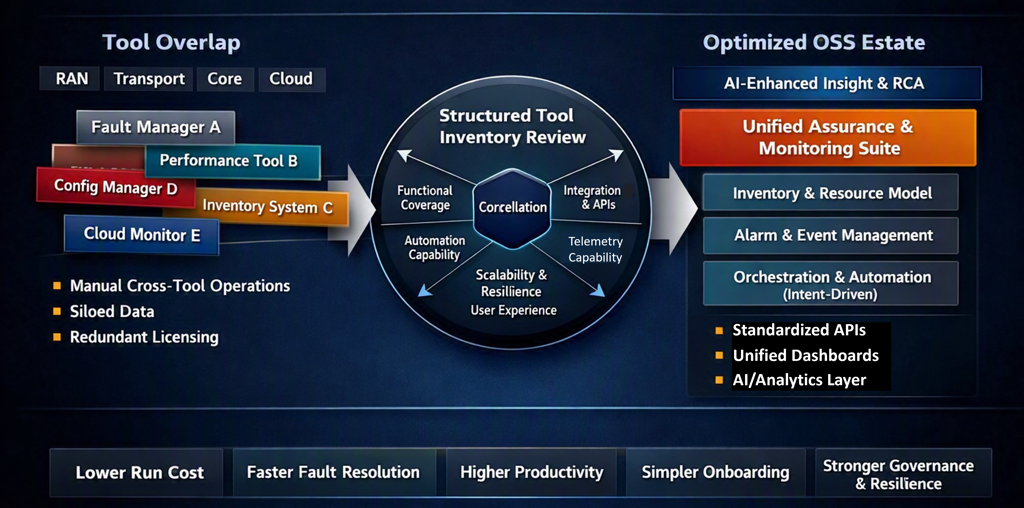
Telecom operators do not suffer from too few tools; they suffer from too many. As networks have grown across RAN, transport, core, and cloud, monitoring, fault, performance, configuration, and inventory platforms have accumulated—most added reactively to solve a single problem. The result is familiar: overlapping functionality, siloed data, manual cross tool operations, and licensing spend on platforms nobody fully uses. A structured tool inventory review helps operators regain control of that sprawl, aligning each platform to a strategic purpose, eliminating overlaps, and confirming that every tool still earns its place in service delivery and resilience.
The sprawl is a by product of how networks evolve. Each domain (RAN, transport, core, cloud) arrives with its own monitoring and control systems, and over time redundant fault, performance, and configuration functions pile up across them. Data silos block cross domain correlation; divergent UIs and processes slow both incident resolution and training; and maintenance and license costs climb as underused platforms persist. An inventory review sorts the estate into what is essential, what can be consolidated, and what should be retired or replaced. That is an OSS architecture decision with budget and operating model consequences, not a housekeeping chore.
A defensible review scores each tool on multiple dimensions. Functional coverage: does it actually handle fault, performance, configuration, and inventory (the OSS FCAPS functions) across the domains you run? Integration: can it interface cleanly with the rest of the OSS/BSS estate, SDN controllers, and orchestration—ideally over TM Forum Open APIs such as TMF638 (Resource Inventory) and TMF642 (Alarm Management) rather than bespoke connectors? Telemetry handling: how well does it ingest, filter, and correlate real time data? Automation capability: does it support closed loop and intent driven workflows? Scalability and resilience: can it absorb data growth and topology change? User experience: is the interface usable, with role based access and workflow customization? Tools that speak standardized interfaces—TM Forum Open APIs and 3GPP intent driven management (TS 28.312)—age better in a multi vendor estate than those that do not.
Technical merit only matters against an operational use case. A performance analytics platform may visualize KPIs beautifully yet lack fault correlation logic; an orchestrator may automate slice lifecycle (via the NSMF/NSSMF) but never touch the inventory system; a legacy fault manager may flood the NOC with topology blind ticket noise. Mapping each tool to the use cases it serves (SLA assurance, slice lifecycle management, predictive maintenance) exposes both genuine value and the gaps, giving engineering, operations, and service teams one shared picture of what each tool is for. The map should also cover emerging uses such as energy optimization and ESG/sustainability reporting, which are becoming policy driven requirements rather than nice to haves.
Lifecycle and vendor posture belong in the same scorecard. Is the platform actively maintained or nearing end of life? Does the vendor track emerging standards and publish a credible roadmap? Is support responsive and documented? Does licensing scale with usage, or lock you into rigid tiers? A technically strong tool can still be the wrong bet if the vendor relationship behind it is weak—and that risk rarely shows up in a feature comparison.
Newer inventory and assurance platforms fold in AI and analytics: predictive insight into capacity and fault probability, anomaly detection across domains, policy and intent based alarm suppression that mutes deviations inside agreed service thresholds, and geospatial visualization of assets and fault clusters for faster triage. Used well, these turn the inventory from a static database into a live operational system that anticipates problems instead of recording them. Several vendors now advertise AI enhanced root cause analysis and automated remediation that cut mean time to resolution—capabilities worth assessing on operator deployed evidence rather than datasheet claims, since the gap between demo and production is where these tools usually disappoint.
With the evaluation in hand, optimization is the payoff: consolidate overlapping platforms into unified suites, retire legacy systems that cannot integrate or automate, and standardize telemetry formats and APIs so the survivors interoperate. Unified dashboards cut the swivel chair tax and sharpen situational awareness. The returns are concrete: lower run cost, faster fault resolution, higher productivity, and simpler onboarding in multi vendor shops. None of it sticks without governance, though, so define tool ownership, update cycles, and performance metrics to keep the estate aligned to business goals instead of drifting back into sprawl.
A well managed network tool inventory delivers measurable benefits across operational and strategic dimensions. It enhances clarity by providing unified data views, accelerates fault resolution through integrated workflows, and reduces overhead associated with licensing and training. Moreover, it strengthens organizational agility, enabling faster adaptation to emerging technologies and evolving service models. It also supports compliance and audit readiness by ensuring that tools meet regulatory standards and offer traceable workflows.
As telecom networks grow increasingly dynamic and intent driven, evaluating and optimizing tool inventory becomes a strategic imperative—far beyond a routine housekeeping exercise. Tool inventory evaluation is not a one time event—it’s a continuous discipline. As networks evolve toward cloud native, AI enabled, and autonomous architectures, the supporting tools must evolve in tandem. Operators who invest in structured inventory reviews position themselves to scale efficiently, respond rapidly, and innovate confidently. Clarity in tooling leads to clarity in operations—and clarity is the foundation of resilience.