Predictive Maintenance: Transforming How Modern Networks Stay Ahead of Failure
Building the Intelligence Layer for Autonomous Networks
6 Minute Read

Quick Summary: “Predictive maintenance moves telecom ops from fix-when-broken to prevent-before-impact by turning multi-domain telemetry into anomaly, RUL, and digital-twin predictions. The hard part is not the model; it is assembling enough high-granularity history across fragmented domains for predictions to be trustworthy.”
Telecom uptime has crossed a line: it is no longer just a KPI to report on; it is a competitive differentiator. As operators move toward AI-native architectures and early autonomy, predictive maintenance is one of the most practical, high-impact steps on that path. Rather than reacting to alarms or rolling a truck after a failure, operators are using telemetry, models, and real-time inference to catch problems before they reach the customer.
The mindset shift is from fix-when-broken to prevent-before-impact, and on always-on networks that shift is strategic rather than optional. Modern networks already emit the raw material: RAN counters, transport KPIs, fiber-loss measurements, power-system logs, environmental sensors, even weather feeds. Historically, that data went into reports; now it feeds machine-learning models that detect anomalies, forecast degradation, and recommend interventions.
Done well, predictive maintenance moves operations from reactive to proactive by combining telemetry, IoT sensors, and analytics to watch equipment health continuously. Operators and vendors cite unplanned-downtime reductions in the 35-45% range and maintenance-cost reductions of 25-30%, figures worth treating as directional until validated against your own baseline, since they come from mixed industry sources rather than a single benchmark.
The MTTR (mean time to repair) gains come from compressing every step of recovery. Problems are detected earlier; AI-driven correlation speeds diagnosis; technicians arrive with clearer guidance; the fix is faster because the fault is pre-identified; and real-time monitoring confirms restoration immediately. Fewer truck rolls and a cleaner recovery cycle strengthen resilience and pull down OPEX.
The downstream benefits follow: stronger SLA performance for enterprise and wholesale customers, higher availability from fewer unplanned outages, longer equipment life from smarter and more targeted maintenance cycles, and improved technician safety because risks are spotted before they escalate. Predictive maintenance has moved from futuristic concept to measurable operational advantage.
Architecturally, a predictive-maintenance system is a few components working together. Continuous data collection from sensors (temperature, vibration, environment) and device logs (latency, traffic, performance counters) feeds AI/ML models that analyze patterns, forecast failures, and estimate Remaining Useful Life (RUL) using anomaly detection, supervised failure prediction, and digital-twin simulation. Those outputs become prescriptive guidance for technicians, and edge computing processes data close to the source so critical events trigger near-instant alerts rather than waiting on a central pipeline.
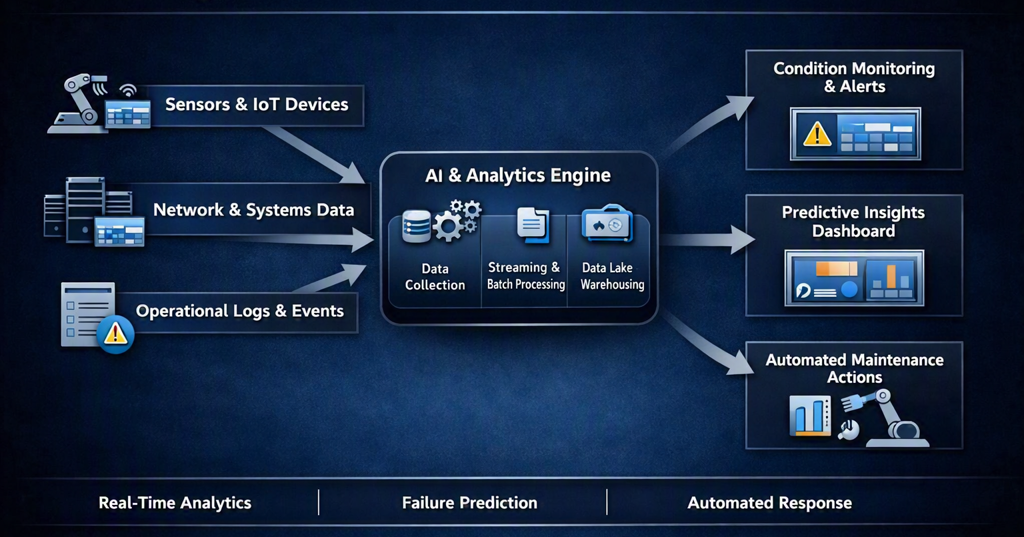
Applied across the estate, this lets operators replace components proactively instead of waiting for failures, improving reliability on fiber, RAN, data-center, and edge assets while trimming unnecessary scheduled work. Industry studies put the gains at roughly 35-50% less equipment downtime, up to 70-75% fewer breakdowns, and 20-40% longer asset life, wide ranges that depend heavily on asset class and data maturity and should be cited with their source rather than as settled fact. (Note this 35-50% downtime figure differs from the 35-45% cited earlier; reconcile to one source before publishing.)
The use cases are concrete. Fiber: detect micro-bends, splice deterioration, and optical-loss trends weeks before service impact. RAN: flag early hardware failure in RRUs/RUs and power amplifiers via temperature drift, VSWR anomalies, and abnormal power draw (the active radio unit, not the passive antenna, is what is being monitored). Power: watch batteries, rectifiers, and generators for aging cells and cooling faults. Transport: catch jitter, latency spikes, and packet-loss patterns early. Even weather-driven risk can be anticipated to pre-position field crews. Several of these run in production at NA Tier 1 and Tier 2 operators today, though the specific operator and scope should be confirmed before stating it as fact.
The barriers are real, and most are about data, not models. Telemetry is fragmented across RAN, transport, core, and power, creating silos that block unified analysis. Data quality is uneven (missing counters, noisy logs, vendor-specific KPIs), which caps model accuracy. Real-time integration is still thin, so many insights are interpreted manually and closed-loop adoption is slow. Vendor fragmentation compounds it: every supplier exposes telemetry differently. And the system needs scarce AI/ML skills and meaningful up-front investment in sensors and platforms. The most underrated barrier is the cold-start data problem: models often need months to a year of high-granularity history to learn degradation and seasonal patterns, yet operators frequently have only weeks of usable data, or data stored too coarsely. Building the storage and processing to hold that history across every domain is expensive, and without it models fail to generalize and the predictions are not trustworthy.
Looking ahead, predictive maintenance becomes the data layer beneath autonomous networks. As AI-native architectures mature, these systems should move from advisory tools toward automated decision engines: closed-loop remediation, self-optimizing maintenance schedules, and cross-domain prediction. Digital twins simulate network health; AI-driven field operations enable dynamic dispatch. In TM Forum Autonomous Networks terms, most predictive maintenance sits at advisory levels (roughly L1-L2) today, with full no-human-in-the-loop remediation (L4+) as the target rather than the current state, a distinction worth keeping so the roadmap stays honest.
Operators that invest in predictive maintenance today are not just improving uptime; they are laying the foundation for the next generation of network intelligence. In a competitive market, the ability to prevent failures before they happen will define the leaders of the AI-native telecom era.