RAN Energy Saving Without Coverage Loss
Why the Revert Path Matters More Than the Mode
7 Minute Read

Radio Access Networks (RAN) account for the majority of a mobile operator’s total energy consumption. As 5G densification accelerates and traffic patterns become more unpredictable, operators face a strategic challenge: how to reduce power usage without reducing coverage. Traditional energy saving mechanisms—static sleep modes, fixed thresholds, and scheduled downtimes—are increasingly insufficient for cloud native, multi layer RAN environments. AI based energy models are emerging as the next evolution. Instead of relying on deterministic rules, these models learn from real time conditions, traffic behavior, and environmental context to make precise, adaptive energy optimizations. Let’s explore how AI models reshape RAN energy efficiency, the architectural frameworks behind these systems, and the operational considerations for deploying them at scale.
RAN sites consume energy continuously, even during off peak hours. Radios, baseband units, and supporting infrastructure remain active to maintain coverage and meet regulatory requirements. As operators expand mid band and massive MIMO deployments, energy consumption rises disproportionately compared to subscriber growth. The challenge is not simply reducing power; it is reducing power without reducing coverage. Any energy saving mechanism must preserve cell availability, mobility performance, and user experience. Deterministic energy saving features often fall short because they cannot adapt to real time network conditions. AI based models offer a fundamentally different approach: coverage aware, predictive, and autonomous energy optimization.
Traditional RAN energy saving features operate on deterministic logic. Radios may enter sleep mode during low traffic periods, or carriers may deactivate based on fixed thresholds. These mechanisms struggle with modern traffic patterns, which fluctuate rapidly due to streaming, gaming, IoT bursts, and localized events. AI based models replace static logic with dynamic prediction. They analyze historical and real time data to forecast traffic demand, identify underutilized resources, and determine the optimal energy saving action for each cell. Instead of turning off carriers based on rigid rules, AI evaluates whether a cell can safely reduce power while maintaining coverage and meeting SLA requirements. This shift enables operators to reduce power consumption more aggressively without compromising network performance.
Traffic forecasting models predict future load based on historical patterns, time of day behavior, seasonal trends, and local events. Forecasting accuracy determines how confidently the system can reduce power without risking congestion or coverage degradation. Coverage preservation models analyze signal strength, mobility patterns, and neighboring cell relationships to ensure energy saving actions do not create coverage gaps. These models validate whether neighboring cells or beamforming adjustments can compensate for reduced power. Sleep mode optimization models determine when radios or carriers can enter low power states. They consider traffic load, user distribution, and mobility trends to avoid frequent on/off cycles that degrade performance. Beamforming and power control models adjust antenna patterns to maintain coverage while reducing transmit power, optimizing output power based on real time SINR, user density, and interference conditions. Multi layer coordination models balance energy usage across macro layers, small cells, and massive MIMO, ensuring that energy saving actions in one layer do not inadvertently increase consumption in another.
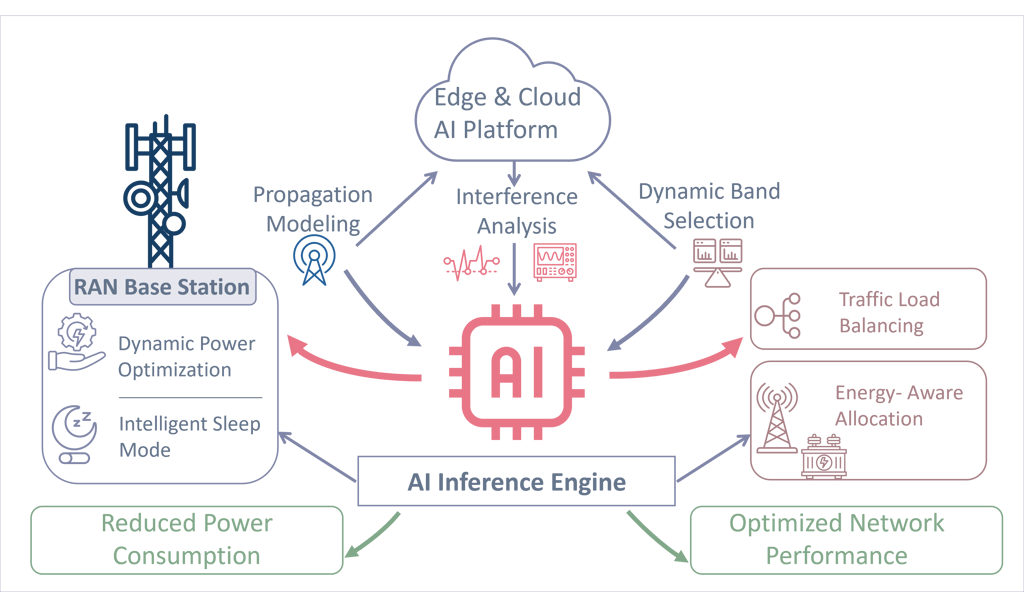
Transmit power is one of the most direct contributors to RAN energy consumption. Every watt transmitted by a radio unit requires several watts of supporting power from amplifiers, cooling systems, and baseband processing. Traditional networks broadcast at fixed power levels even when user density or SINR conditions do not require full output. AI based power control models continuously adjust transmit power based on real time conditions. Instead of static broadcasting, the system evaluates user distribution, channel quality, interference patterns, and mobility trends to determine the minimum power required to maintain coverage. Energy savings occur through lower power amplifier load, reduced cooling requirements, and optimized massive MIMO operation, where AI selectively deactivates antenna branches or simplifies beamforming when full spatial multiplexing is unnecessary. This closed loop system scales power up instantly if SINR drops or user density increases, ensuring coverage preservation. Real world deployments show 8%–15% energy reduction from power control alone.
AI based RAN energy efficiency relies on architectural frameworks that support safe and scalable automation. Distributed intelligence at the edge allows models to react quickly to local conditions, enabling real time adjustments to power levels, sleep modes, and beamforming patterns. Centralized policy and governance ensure that operators define constraints such as minimum coverage requirements, regulatory limits, and SLA thresholds, with AI models operating within these boundaries. Closed loop automation enables models to monitor conditions, execute actions, verify outcomes, and reverse decisions if performance degrades, ensuring stability and preventing unintended consequences. Integration with SON systems and RAN Intelligent Controllers (RIC) provides topology awareness and near real time control of RAN functions, forming the foundation for intelligent energy optimization.
Real world use cases demonstrate how AI transforms RAN energy efficiency. AI optimized sleep modes identify low demand periods and place radios or carriers into sleep mode while preserving coverage through neighboring cells or beamforming. Dynamic power scaling adjusts transmit power based on real time user distribution and SINR conditions. Massive MIMO energy optimization determines when full beamforming capabilities are needed and when simplified configurations can maintain coverage with lower power. Multi layer load shaping shifts traffic intelligently between macro and small cells to optimize energy usage.
Deploying AI based energy efficiency requires accurate telemetry, robust governance frameworks, and careful integration with OSS, SON, and RIC systems. Operators must continuously monitor KPIs such as call drop rate, handover success rate, and throughput to ensure energy savings do not compromise user experience. AI models in Radio Access Networks reduce base station power consumption by 10% to 33% without dropping coverage by dynamically adapting power states to real time traffic. Machine learning predicts traffic lulls and turns off underutilized 4G/5G cells or specific frequency bands, instantly waking them when demand returns. Algorithms disable selected antenna branches in Massive MIMO setups during lower demand windows while keeping baseline coverage intact. AI targets signals precisely to active users rather than broadcasting uniformly, saving power during variable loads. Systems shift connected devices smoothly to neighboring active cells before powering down specific hardware. One of the major telecom vendors' pilot sites running AI powered energy optimizers achieved a 10% to 12% energy reduction with zero degradation in call drop rates or throughput. The other’s energy efficiency solutions demonstrate up to a 30% reduction in energy costs without impacting customer experience. Open RAN alliances using closed loop reinforcement learning and clustering rApps/xApps have cut overall power usage by up to 33% in testing environments.
AI based RAN energy efficiency represents a practical and scalable approach to reducing power consumption without reducing coverage. As networks become more complex and traffic patterns more unpredictable, deterministic energy saving mechanisms will continue to fall short. AI models provide the adaptability, precision, and coverage preservation needed to optimize energy usage across diverse RAN environments.
The transition is gradual, shaped by each operator’s network architecture, modernization strategy, and operational priorities. But the direction is clear: energy efficiency will increasingly depend on intelligent, predictive, and autonomous RAN systems.