

Service Level Agreements (SLAs) have long defined how operators communicate performance guarantees, but enforcement has traditionally been retrospective. Operators review KPIs after the fact, generate monthly compliance reports, and negotiate credits only after customers have already experienced service degradation. In modern networks built around cloud applications, containerized workloads, dynamic network slices, and automated orchestration, this delayed model is no longer viable. Real Time SLA Enforcement introduces a new operational model by converting static contractual terms into executable network policies that continuously monitor, enforce, and maintain service performance. Instead of discovering SLA violations after they occur, the network enforces SLA requirements as active constraints.
Conventional SLA management assumes predictable traffic patterns, stable topologies, and manual oversight. Today’s networks are highly dynamic. 5G slices are created and removed on demand, traffic paths adjust automatically, workloads shift across multi cloud environments, and UPF instances scale based on load. Static SLAs cannot govern systems that change continuously, creating a gap between contractual expectations and real time network behavior. Real time enforcement closes this gap by embedding SLA logic directly into the control plane.
The shift begins by treating SLAs as policy objects rather than documents. Each SLA clause becomes a policy threshold—latency limits, jitter tolerances, packet loss budgets, availability targets, and minimum bandwidth requirements. These thresholds are evaluated against live telemetry from RAN, transport, core, and cloud domains. When performance deviates from the defined thresholds, the network immediately adjusts traffic paths, reallocates resources, or scales slices. The SLA becomes an operational policy rather than a historical measurement.
Real time SLA enforcement operates through a continuous feedback loop built on three core capabilities. First, real time telemetry replaces slow polling. Instead of SNMP queries every five minutes, modern networks rely on gNMI streaming telemetry, synthetic BFD probes, optical signal metrics, UPF counters, and cloud service traces. These data sources provide continuous visibility into path performance, congestion, jitter, and packet loss. Second, SLA clauses are translated into policy thresholds. For example, a 99.99% availability requirement becomes a link state and BFD driven failover policy; a voice quality requirement becomes latency under 150 ms and jitter under 30 ms enforced through real time path selection; and a priority traffic requirement becomes a utilization threshold above 85% that triggers rate limiting of non critical applications. The policy engine continuously compares live telemetry against these thresholds. Third, when a threshold is violated, the system initiates corrective actions through SDN controllers, slice orchestrators, SRv6 path updates, eBPF based traffic filtering, SD WAN steering, or cloud APIs. Traffic is rerouted or resources are scaled within milliseconds—well before users notice any degradation.
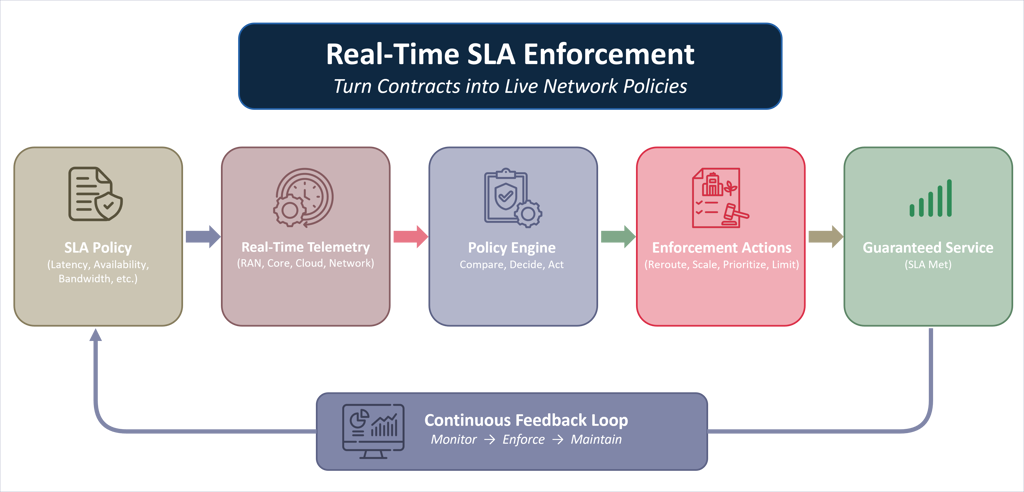
A practical example illustrates this behavior. Consider a 5G enterprise slice guaranteeing sub 20 ms latency for AR/VR traffic. As congestion builds on a transport segment, telemetry detects rising delay. The policy engine identifies an impending SLA violation. The SDN controller selects a lower latency optical path, and the slice orchestrator scales UPF instances closer to the edge. The entire remediation cycle completes in seconds. The SLA remains intact not because it was measured, but because it was enforced in real time.
Several technologies enable this operational model. SD WAN dynamically selects the best available path across MPLS, broadband, and 5G transports. Segment Routing over IPv6 (SRv6) allows the controller to define explicit paths that meet SLA requirements. Network slicing in 5G and 6G creates isolated virtual networks with guaranteed performance characteristics. eBPF provides fine grained traffic filtering and rate limiting at kernel level. Intent Based Networking allows operators to define service intent—such as maintaining a specific latency tier—while the system ensures configuration compliance across the network.
Real time enforcement introduces engineering constraints that must be managed carefully. If a link experiences a brief degradation and quickly recovers, immediate rerouting can destabilize the network. Controllers use hysteresis to ensure performance issues persist before switching paths. When multiple premium SLAs degrade simultaneously, the controller must apply business defined priorities, ensuring Tier 1 contracts receive guaranteed bandwidth while lower tier traffic is shaped or reduced. These considerations require careful policy design to avoid cross domain performance impacts.
Real time enforcement is evolving toward proactive SLA assurance. Machine learning models trained on historical telemetry can identify pre failure indicators such as optical signal to noise fluctuations, buffer micro bursts, latency oscillation patterns, and UPF CPU saturation trends. The system can reroute traffic away from a degrading asset before an SLA violation occurs. The future also includes automated SLA credit settlement through blockchain based smart contracts. When a verified SLA violation occurs and cannot be mitigated, telemetry triggers a smart contract API that automatically issues service credits. This removes manual auditing and administrative overhead, turning SLA settlement into an automated process.
Real time SLA enforcement reshapes operator accountability. Customers receive consistent service performance rather than monthly averages. Operators reduce penalties and introduce differentiated service tiers. Automation systems gain measurable objectives for closed loop control. Multi vendor environments benefit from API based SLA policies that simplify coordination. SLAs evolve from static documents into dynamic policies continuously interpreted and enforced by the network.
As networks progress toward autonomous operation, SLAs will no longer function as passive agreements. They will become active, programmable constraints embedded directly into the control plane. Real time SLA enforcement merges business intent with technical configuration, translating SLA terms into operational policies. Operators who adopt this model will not only meet performance expectations—they will maintain them continuously. In environments where milliseconds matter, real time SLA enforcement becomes the foundation for reliable, differentiated, and autonomous network services.