Network Task Orchestration Is Not Automation
The Cross-Domain Coordination Layer That Closes the Loop Across RAN, Transport, Core, and Cloud
6 Minute Read

TL;DR: Orchestration is the cross-domain coordination layer that turns a service intent into provisioned functions, monitors the KPIs, detects anomalies, and remediates — without a human in the loop for the routine cases. Anchored to ETSI NFV-MANO, O-RAN SMO/Non-RT RIC, and 3GPP intent-driven management (TS 28.312), it is the difference between scripted automation and a self-correcting service lifecycle.
Standing up a single enterprise 5G slice can touch a dozen systems — the NFV orchestrator, the SDN controller, the RAN's element manager, the transport provisioning system, and the cloud platform underneath — each owned by a different team and, often, a different vendor. The proliferation of 5G, edge computing, and cloud-native architecture has not just raised the bar on agility and scale; it has multiplied the number of moving parts an operator must coordinate to deliver one service.
Many networks still run on legacy operating methods: siloed OSS/BSS stacks, manual configuration, and reactive troubleshooting. Provisioning a service can take days or weeks; monitoring catches faults after customers feel them; and scaling decisions lean on engineering intuition rather than telemetry. Those habits are increasingly misaligned with disaggregated, multi-vendor infrastructure.
The closed-loop service lifecycle: orchestration turns an intent into provisioned functions, monitors KPIs, detects anomalies, and remediates — then loops back to monitoring without a human in the routine path.
Closing that gap takes more than another script. Orchestration is the cross-domain coordination layer that aligns disparate components — RAN, transport, core, and cloud — into a single service-delivery control plane, governed by policy and intent rather than per-element handoffs.
This is where the orchestration-versus-automation distinction matters. Automation executes a predefined task: a script reboots a node, a playbook pushes a config. Orchestration arranges and coordinates many such tasks across domains, adding dynamic decision-making, policy enforcement, and lifecycle management. ETSI's NFV-MANO architecture names this explicitly — the NFV Orchestrator (NFVO) sits above the VNF Managers and Virtualised Infrastructure Managers it directs. Open-source stacks such as Linux Foundation ONAP and the Kubernetes-native Nephio occupy the same layer for cloud-native functions.
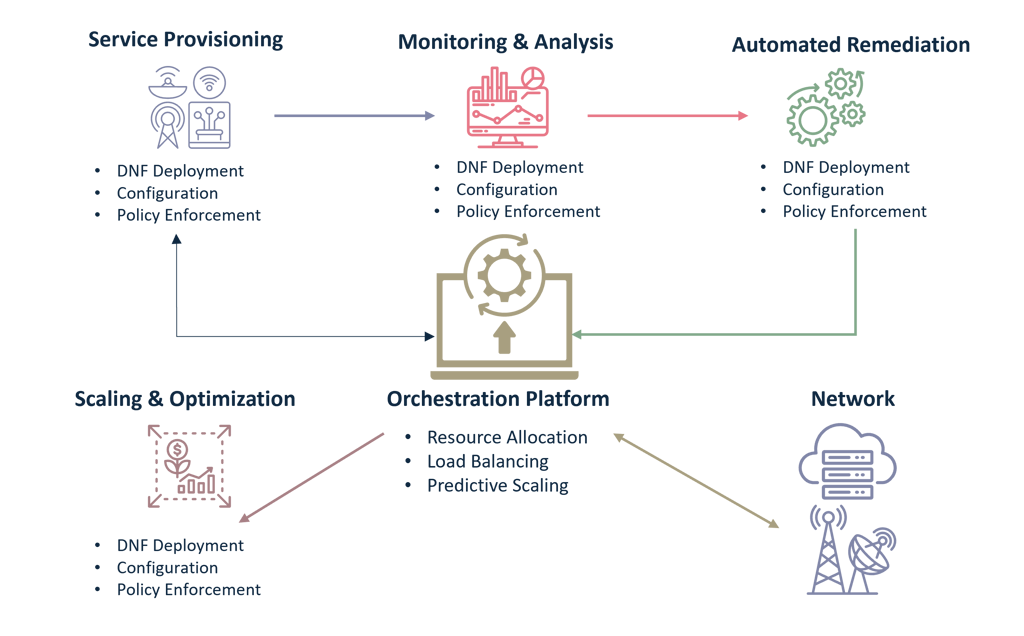
For operators, the orchestrator owns the full service lifecycle — provisioning, configuration, monitoring, and remediation — and that ownership is what makes multi-vendor 5G deployments and edge rollouts tractable. The harder the integration, the more the coordination layer earns its keep.
Orchestration workflows span domains: onboarding VNFs (and increasingly CNFs), allocating compute, stitching service chains, and enforcing security policy across RAN, transport, core, and cloud. Deploying an enterprise 5G slice instance (NSSI), the orchestrator provisions the required network functions, configures routing, and applies QoS from templates conditioned on real-time state — the slice-provisioning flow 3GPP standardizes in TS 28.531. Done well, this improves consistency, cuts manual error, and shortens time-to-market; done poorly, it hard-codes one vendor's assumptions into every service.
Orchestration also carries governance. Embedding compliance checks and audit trails into workflows lets operators enforce requirements such as data sovereignty or lawful intercept as part of provisioning rather than as an after-the-fact review — lowering non-compliance risk and giving enterprise customers and regulators something auditable.
Measurement is what separates orchestration from a black box. KPIs instrumented directly in the workflow — service instantiation time, resource utilization, fault-recovery duration, policy compliance rate — turn the lifecycle into something an operator can manage to an SLA. Tracking how long it takes to deploy a virtual firewall across edge nodes, for instance, surfaces bottlenecks in resource allocation or configuration propagation that no single element manager would reveal.
Wired into telemetry and a data lake, the orchestrator can run a genuine closed loop. Workflow execution traces — timestamps, state transitions, exception events — let it visualize service paths, spot latency hotspots, and trigger remediation. When a virtual router in a service chain fails, the engine detects the anomaly, reroutes traffic, and instantiates a replacement function without a human. This is the closed-loop pattern ETSI's Zero-touch Network and Service Management (ZSM) framework is built around, and it is the pivot from reactive to proactive operations.
Orchestration is also moving toward intent-based networking. Operators declare an outcome — "hold video QoE during peak hours" — and the engine translates that intent into executable workflows, monitors compliance, and corrects drift. 3GPP's intent-driven management work (TS 28.312) and TM Forum's intent and Open API frameworks (part of the ODA) give this a standards basis, so the abstraction is portable across vendors rather than locked to one platform's macro language.
Analytics deepen the loop. Mining orchestration logs and telemetry surfaces recurring failure signatures and underutilized compute; dashboards and heatmaps make congestion and policy violations visible; predictive models forecast demand so capacity can scale ahead of an event. In an O-RAN architecture, this is the natural home of the Non-RT RIC and its rApps, which run exactly these data-driven optimization functions above the SMO. Scenario simulation lets operators test a vendor swap or template change before it touches production.
None of this is one-and-done. Run against a Plan-Do-Check-Act loop, operators model a workflow, execute it, measure the outcome, and tune — for example, simulating a core-function migration to public cloud to compare latency, cost, and fault tolerance against an on-premises baseline before committing. Iteration is the point.
Another dimension is workforce enablement, with a caveat. Low-code interfaces and dashboards let operations teams build and adjust workflows without deep programming, which broadens who can participate and reduces single-person dependencies. But low-code is not no-code: complex cross-domain logic still needs engineering review, and the governance burden moves rather than disappears.
So orchestration is not only a technical capability; it is a strategic one. Embedding intelligence in service workflows, instrumenting real-time analytics, and committing to continuous optimization is what lets operators deliver agile, resilient, customer-focused services at scale — and turn network operations from a cost center into a differentiator. Measured against the reactive, manual baseline, the operational advantage is real, but it is earned through integration work, not bought off a slide. Looking ahead, orchestration is the substrate for autonomous networks, where agents adapt to traffic, security, and application demand within policy guardrails. Paired with predictive analytics, the trajectory is toward self-correcting infrastructure that anticipates faults rather than only reacting — a direction the industry is moving, with the honest caveat that fully self-healing, cross-domain operation remains aspirational for most operators today.