Backhaul’s New Era: Fiber, Microwave & LEO Converge
How Fiber, Microwave & LEO Converge into a Unified Last‑Mile Strategy
6 Minute Read

The last-mile backhaul environment in 2025-2026 is undergoing one of its most significant shifts in a decade. What was once a debate about choosing the 'best' technology has evolved into a more pragmatic, hybrid approach. Fiber, microwave, and Low Earth Orbit (LEO) satellites are no longer positioned as rivals. Instead, they are becoming complementary layers in a unified backhaul strategy — each solving a different part of the coverage, cost, and capacity puzzle.
Operators are being pushed by rising traffic, rural coverage mandates, and climate-driven resilience requirements. At the same time, AI-related workloads and Wi-Fi 7/8 adoption are accelerating demand for high-capacity links. The result is a backhaul landscape where flexibility matters as much as raw performance, and where the real competitive race is between operators who can deploy intelligently, not between the technologies themselves.
Fiber remains the gold standard for last-mile backhaul, especially in dense urban and suburban environments where demand for bandwidth continues to climb. Its strengths — virtually unlimited capacity, low latency, and long-term reliability — make it the natural anchor for high-density 5G and enterprise zones. The market reflects this momentum. Last-mile fiber is projected to grow from $5.62 billion in 2024 to nearly $10 billion by 2030, driven by AI-heavy applications, cloud gaming, UHD streaming, and enterprise connectivity. Operators are also adopting denser fiber cables and plug-and-play deployment kits to reduce installation complexity and speed up rollouts. Yet fiber's biggest challenge remains unchanged: cost. Trenching, permitting, and environmental barriers make fiber economically difficult in rural or rugged terrain. Even with improved deployment tools, timelines remain long and capital expenditure high. This is why fiber increasingly serves as the core, while other technologies fill the edges where fiber becomes impractical.
Microwave backhaul continues to play a critical role in 5G networks, particularly where fiber deployment is too slow or too expensive. Today, microwave supports around 75% of live 5G networks globally, and its installed base is expected to remain strong well into the next decade. Modern microwave systems — especially E-band and V-band — are capable of 10 Gbps+ throughput, making them competitive with fiber for many high-capacity use cases. Their advantages are clear: rapid deployment, predictable latency, and significantly lower cost per link. These strengths make microwave ideal for suburban pockets, rural clusters, temporary sites, and areas where trenching is difficult. While microwave does face constraints such as line-of-sight requirements, spectrum licensing, and weather sensitivity at higher frequencies, its agility and cost-effectiveness make it a strategic tool for operators expanding coverage quickly.
LEO constellations — including major global providers — have transformed satellite backhaul from a last-resort option into a high-performance, low-latency alternative. Their ability to deliver 'fiber-like' latency without ground infrastructure is reshaping rural and remote connectivity strategies. The satellite backhaul market is projected to grow from $3.55 billion in 2025 to over $6.8 billion by 2030, driven by rural expansion, maritime connectivity, and mobility use cases. Solutions like Lightspeed are positioning LEO as 'fiber in the sky,' offering high-capacity, low-latency links suitable for both primary and backup backhaul. LEO's role is increasingly complementary. It provides primary backhaul for remote towers, rapid failover for fiber cuts, and a resilience layer for disaster-prone regions. As climate-driven outages become more frequent, LEO's ability to restore connectivity within minutes is becoming a strategic advantage.
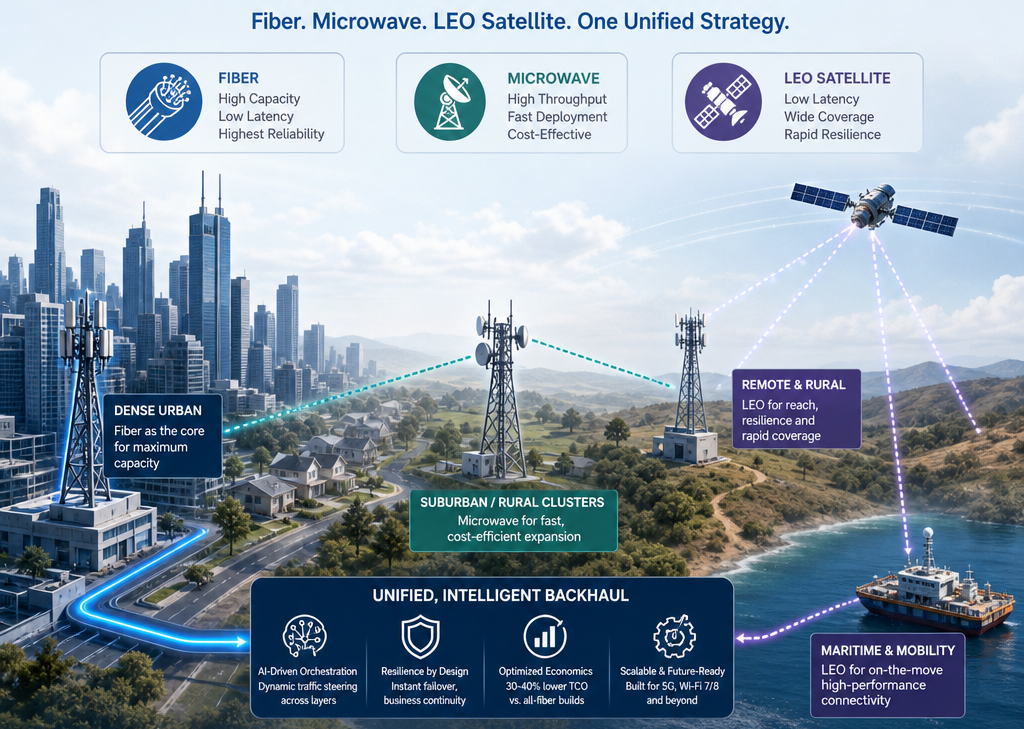
A hybrid backhaul model is rapidly becoming the centerpiece of operator strategy. Across markets, the most competitive networks are shifting toward multilayer architectures that blend fiber, microwave, and LEO into a single orchestrated system. This approach lets operators tailor backhaul to geography, population density, and economic constraints. Fiber and microwave are emerging as the preferred combination for suburban and semi-urban expansion, while fiber paired with LEO is gaining traction for resilience, rural reach, and rapid failover. In regions where fiber is economically unrealistic or environmentally restricted, microwave and LEO are becoming the practical alternative. AI-driven network management is accelerating this transition by dynamically steering traffic across layers, reducing the total cost of ownership by 30-40 percent compared to all-fiber builds. As a result, the industry is moving toward a realistic 2030 scenario where backhaul is split evenly between fiber and wireless technologies.
The economics behind these decisions are shaped by several competing variables. Operators must weigh the cost per mile of fiber against the cost per link for microwave and the cost per terminal for LEO. Deployment timelines vary widely, from months for fiber builds to just days for LEO activation. Regulatory friction — permits, rights-of-way, and spectrum licensing — adds another layer of complexity. Resilience also plays a major role, as operators balance the risks of fiber cuts, weather-related microwave disruptions, and satellite congestion. Scalability differs across technologies, with fiber offering near-infinite headroom, microwave providing moderate growth potential, and LEO performance depending heavily on constellation design. The real competitive advantage lies with operators who can optimize these variables faster and more intelligently than their peers.
Hybrid backhaul is entering a decisive phase, and the period from 2026 to 2030 will cement it as the industry standard. Operators are no longer choosing between fiber, microwave, or LEO — they are orchestrating all three to match geography, economics, and deployment speed. Fiber will continue densifying high-value urban corridors, but its cost and construction timelines limit how far it can extend. Microwave has matured into a high-capacity, rapid-deployment option for suburban and rural growth, while LEO satellites have unlocked new possibilities for resilience, universal service, and disaster recovery. As operators push deeper into rural markets, accelerate 5G rollouts, and prepare for Wi-Fi 7/8-driven traffic surges, this flexible mix becomes essential.
In this new landscape, the real race is not between fiber, microwave, and LEO — it is between operators who can combine them most effectively to deliver reliable broadband everywhere. Winning it depends as much on planning discipline and skilled teams as on the technologies themselves.