

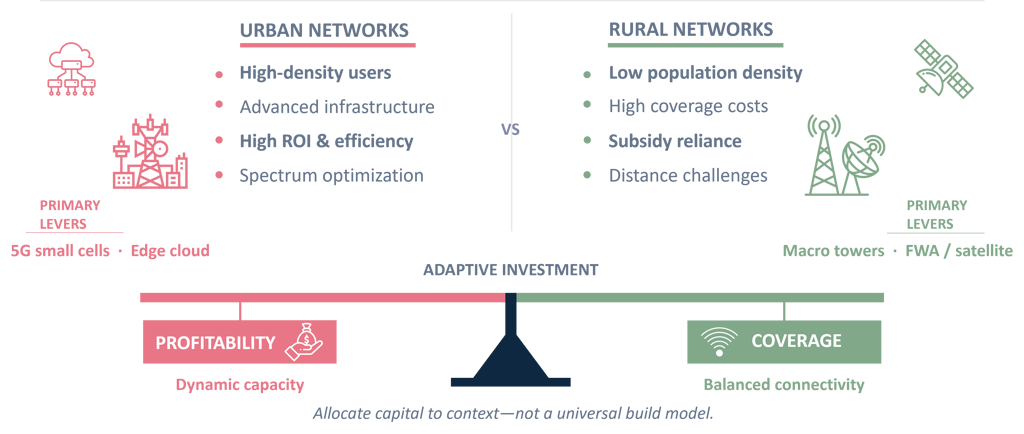
The coverage cost curve has inverted. Urban networks are now expensive to sustain; rural networks remain expensive to reach. Urban markets still deliver high traffic density, fast payback, and predictable upgrade cycles, while rural regions stretch capital budgets across large geographies with low population density and uneven demand. As networks move toward AI-native, cloud-distributed architectures, capital allocation models built on population density alone no longer fit. Operators need an investment framework that ties coverage decisions to measured, changing economics rather than static geography.
Why the density-first model broke: For decades, coverage planning followed a linear logic: build where subscribers are concentrated, then expand outward as demand grows. Dense urban deployments justified macro and small-cell grids because traffic volumes quickly offset capital expenditure. Rural deployments relied on long-range macro sites, often subsidized or delayed because of low utilization.
This model worked in the 3G and early 4G eras, when traffic growth was predictable. In the 5G and edge-compute era, traffic fluctuates by hour, device type, and application, and coverage economics based solely on population density no longer reflect how the network is actually used.
Urban networks now face diminishing returns: spectrum fragmentation, site leasing, and power costs are rising faster than revenue per bit. Rural networks benefit from lower spectrum congestion and cheaper land, but carry high backhaul and maintenance costs. That is the inversion: urban areas are expensive to sustain; rural areas are expensive to reach.
Operators need to treat coverage investment as a dynamic optimization problem, allocate capital across macro, small-cell, satellite, and edge-compute domains using measured utilization and cost data, revisited every planning cycle, rather than fixed geographic assumptions.
Urban: economies of density. Urban telecom economics are defined by economies of density. A single macro site or small-cell cluster can serve thousands of active users, spreading fixed costs across a large subscriber base. Dense urban footprints typically generate the majority of an operator's net operating profit, effectively subsidizing coverage elsewhere in the footprint.
Urban deployments face local complexity — civil works constraints, building access, and strict permitting — but high ARPU offsets these costs. Open RAN deployments and cloud-native virtualized RAN (vRAN) deliver their highest returns in dense markets, outperforming legacy integrated RAN by 11% to 31% in net present value (NPV) over a 10-year lifecycle.
Urban investment strategy now looks like microeconomic optimization: energy efficiency through AI-based power control such as cell and carrier sleep modes, spectrum reuse through dynamic spectrum sharing (DSS), edge offload (MEC with local breakout) to cut transport costs, and infrastructure sharing through neutral-host and fiber co-investment models. Urban networks remain the financial engine, but their economics now hinge on efficiency rather than expansion.
Rural: the tyranny of distance. Rural networks operate under a fundamentally different cost structure. As population density falls, profitability drops sharply: rural sites often incur equal or greater power, backhaul, and maintenance costs while serving a fraction of the user base. Four pressures dominate:
- Cost dispersal. Fixed costs are spread across too few subscribers. - Maintenance inflation. Larger travel territories and lower grid reliability push up OpEx. - Capital recovery burden. Fixed-network data illustrates the scale: in rural FTTH deployments, 54% of monthly cost is tied to depreciation, cost of capital, and taxes, compared with 45% nationally. - Availability–adoption gap. Subsidized rollouts increase physical coverage but often fail to achieve proportional adoption because of willingness-to-pay constraints.
Rural economics are governed by the tyranny of distance: a geographic penalty that inflates both CapEx and OpEx.
AI changes both urban and rural economics through intent-driven orchestration. Operators declare intents — coverage targets, energy budgets, SLA thresholds — through an intent-management interface (TM Forum TMF921 is the reference API), and multi-agent systems execute them, with humans approving exceptions until the operator reaches the higher TM Forum Autonomous Networks levels. Planner agents forecast demand and allocate resources, topology agents validate feasibility across RAN and transport, configuration agents implement changes, and triage agents handle anomalies and re-optimize the loop. Investment decisions then evolve with network behavior rather than with static planning cycles.
Cloud-native infrastructure further blurs the line between capital and operating expenditure. Pay-as-you-grow models let operators scale compute, storage, and radio capacity in step with demand. Rural deployments start small and expand only when utilization justifies the cost; urban networks turn fixed assets into programmable resources monetized through network slicing on a 5G standalone (SA) core and through enterprise services. The trade-off is a larger recurring OpEx line and closer dependence on cloud and software licensing terms, so capital efficiency comes from operational flexibility, not for free.
Coverage investment cannot rely on market forces alone; regulators and governments balance urban and rural economics. Four instruments matter most: performance-based subsidies tied to measured coverage and quality; shared spectrum licensing for rural and community networks, of which CBRS in the US is the working example; infrastructure neutrality rules that encourage shared fiber and tower access; and green incentives for energy-efficient deployments. These frameworks align public goals with operator economics, so coverage expansion stays both profitable and equitable.
Telecom sustainability requires abandoning one-size-fits-all blueprints. A unified coverage fabric is emerging, built on three elements: hybrid financing models that de-risk rural capital burdens; infrastructure sharing and neutral-host architectures that reduce duplication; and asymmetric technology mixes — deep fiber and small cells in cities, FWA and LEO satellite backhaul at the rural edge. Coverage becomes intent-driven, and investment follows measured demand.
Operators that adopt this model deploy resources where they deliver the highest marginal value rather than where coverage maps dictate. Urban and rural network economics are converging on a single principle: adaptive investment. AI-native orchestration, modular infrastructure, and continuous economic feedback let operators manage coverage as a portfolio of assets with measured returns rather than as a sunk cost.
Three questions make the shift concrete for the next capital planning cycle:
- Is site-level profitability measured from telemetry and utilization data, or still inferred from population density? 2. Which rural sites can start as modular builds (FWA, LEO backhaul) with explicit utilization triggers for expansion? 3. Which urban clusters belong on a neutral-host or fiber co-investment path rather than a stand-alone build?
The result is a network that grows smarter, leaner, and more equitable—an architecture where every watt, every site, and every dollar contributes to a balanced, sustainable connectivity fabric.