Weather-Adaptive Mobile Networks
Fusing Climate Models Into Real-Time Network Optimization
6 Minute Read

Quick Summary: “Weather-adaptive RAN fuses downscaled climate models and environmental sensing with AI prediction to drive real-time RAN actions: beam steering, preemptive handover, and power and cooling control. The near-term play is to instrument high-risk sites and close one weather loop, measured against a reactive baseline.”
For decades, mobile networks have been optimized around traffic patterns, mobility, and spectrum efficiency. Weather was treated as an external factor — something operators reacted to when storms disrupted microwave links or heat waves stressed equipment. Climate volatility is breaking that assumption. As extreme weather grows more frequent and less predictable, the RAN can no longer afford to be blind to its environment. Weather-adaptive networks fuse climate models, environmental sensing, and AI-driven prediction directly into Radio Access Network (RAN) optimization — turning weather from a background condition into a control input.
Weather has always influenced radio performance, but the impact is amplified by the rise of high-band spectrum and the growing volatility of global climate. Rain fade hits microwave and mmWave links, fog and humidity degrade high-band 5G, heat waves force radios and baseband units to throttle, and snow accumulation shifts antenna tilt and loads tower structures. Even fiber routes are vulnerable to flooding and temperature stress. As networks densify and lean harder on mmWave and upper-mid-band spectrum, weather becomes a first-order variable rather than a background condition.
The shift is from reactive troubleshooting to predictive environmental optimization. Climate data is no longer something operators check after an outage — it is becoming a real-time input to the RAN. The fusion spans multiple time horizons: nowcasting windows of zero to two hours (radar plus AI models predicting hyperlocal rain, fog, and wind), short-term forecasts of temperature, humidity, and storm fronts, seasonal patterns such as monsoon cycles and heat and snow seasons, and long-range climate trends that reveal regions turning wetter, hotter, or more storm-prone. These feed RAN decisions on beamforming and tilt, power allocation, link adaptation, carrier-aggregation strategy, backhaul routing, and energy optimization. RAN optimization moves from traffic-driven to climate-aware.
Weather-adaptive networks rely on a layered intelligence stack that merges environmental data with RAN control loops. The environmental sensing layer collects real-time signals from national weather services, radar and satellite feeds, IoT sensors, and RF-based environmental sensing — a natural extension of the integrated sensing and communication (ISAC, also called JCAS) work under study in 3GPP Release 19 and targeted for 6G. High-resolution climate models are downscaled from global ~100 km grids to 12 km or even 1 km blocks, enabling site-level prediction. Research institutions such as Argonne National Laboratory are advancing this localized downscaling, giving operators microclimate visibility tower by tower.
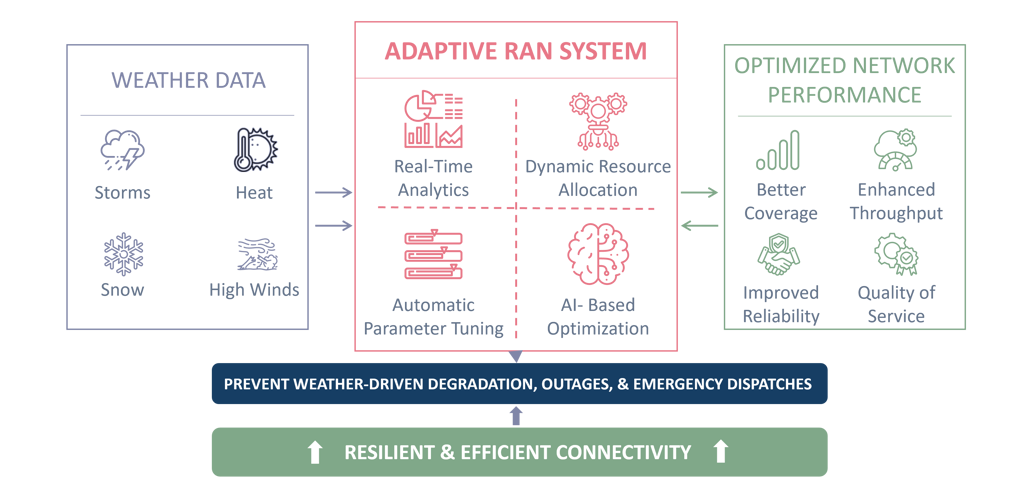
The AI climate-interpretation layer turns raw weather data into radio-relevant predictions: expected rain fade on microwave links, mmWave attenuation from fog or humidity, wind-induced tower sway and beam misalignment, thermal stress on radios during heat waves, and the likelihood of power or fiber disruption. Hybrid systems that pair Numerical Weather Prediction (NWP) with AI emulators can produce high-resolution, low-latency forecasts faster than NWP alone. By correlating weather hazards with network-health data, operators can anticipate equipment failures and secure or redirect capacity before storms hit.
Once the network understands the weather, the RAN optimization layer adapts in real time: dynamic beam steering to offset predicted attenuation, preemptive handovers ahead of weather-induced degradation, modulation-and-coding (MCS) adjustments against forecasted SNR, power boosts or cuts tied to atmospheric absorption, traffic reroutes to more resilient backhaul, and cooling and energy changes during extreme heat. The same forecasts drive energy strategy — anticipating solar-generation dips under cloud cover or heat-driven cooling loads, shifting to grid power, or activating cell sleep modes to support net-zero goals. During heat events, traffic can be offloaded to cooler adjacent cells to prevent equipment derating or shutdown.
This is not theoretical — operators are already piloting early capabilities. Rain-fade prediction lets microwave links pre-boost power or switch paths before degradation. Fog, humidity, and snow can be forecast and compensated with beam adjustments, fallback carriers, or dynamic spectrum shifts in mmWave 5G and 6G. Storm-tracking models help rural sites prepare for outages, reroute traffic, or activate backup power. Before hurricanes, atmospheric rivers, or blizzards, the network can preposition capacity, adjust backhaul, and harden critical routes. Some carriers already use 30-year climate projections to flag towers exposed to inland flooding, high-intensity winds, or wildfire — directing investment in backup power, floodproofing, and structural reinforcement.
The payoff is concrete: fewer outages through predictive mitigation, lower OPEX from fewer emergency dispatches and less hardware stress, better SLA compliance for enterprise and government customers, and higher customer satisfaction during extreme-weather events. Weather-adaptive operations also help with regulatory alignment as climate-resilience mandates grow, and offer differentiation in harsh-climate markets. Hazard-probability models let operators get ahead of outages, and climate-informed site planning reduces long-term environmental exposure, extending asset life. Operators should baseline these gains against their own outage and dispatch data rather than assuming vendor-quoted figures.
5G Advanced already lays groundwork with environmental-sensing hooks, AI-native RAN features, and early ISAC frameworks. By the time 6G arrives, climate-aware optimization should be a native capability rather than a bolt-on. The 2030 network will not just respond to weather — it will predict, adapt, and optimize around it. The near-term move for operators is smaller than a 6G program: instrument the highest-risk sites with microclimate data, wire one closed loop (rain-fade pre-boost or heat-driven offload), and measure it against today's reactive baseline.